

Shenzhen, Guangdong, China – November 19, 2026
Next-generation embedded hardware, aerospace systems, and AI edge computing platforms require timing solutions that withstand severe mechanical vibration, thermal shocks, and EMI. As a specialized authorized SiTime MEMS Oscillator Distributor, our organization provides developers with access to silicon MEMS timing solutions. Silicon MEMS timing devices eliminate the physical limitations of traditional quartz crystals, offering superior durability, compact footprints, and configurable output architectures.
Unlike quartz resonators that rely on fragile mechanical blanks, silicon MEMS oscillators integrate an ultra-clean silicon resonator directly with advanced CMOS driver circuitry. This monolithic integration enhances reliability and shortens supply lead times through distributor-level field programming. Analyzing the technical attributes and supply chain benefits of MEMS oscillators helps procurement and design teams optimize their hardware architectures.
Silicon Architecture Versus Quartz: Resilience to Mechanical Shock and Thermal Ramps
Traditional quartz resonators use a thin quartz blank suspended between metal electrodes inside a ceramic housing. This physical cantilever structure is susceptible to shock damage, microphonics, and package leakage. Silicon MEMS resonators address these failure modes through advanced semiconductor engineering.
Extreme Mechanical Shock Resistance: SiTime silicon MEMS resonators withstand mechanical shocks exceeding 30,000 g and continuous vibration up to 70 g. In contrast, standard quartz crystals risk structural fractures when mechanical shock exceeds 1,500 g. This mechanical strength makes MEMS timing devices ideal for aerospace avionics, industrial robotics, and drilling sensors.
Thermal Stability Under Rapid Temperature Ramps: Quartz crystals suffer frequency perturbations and activity dips when subjected to fast thermal gradients. MEMS oscillators incorporate active temperature sensors and dynamic digital compensation circuitry. This architecture maintains frequency stability down to 0.1 PPM, even during steep thermal transients.
Hermetic Silicon Packaging Reliability: Resonators are vacuum-sealed at the wafer level using epitaxial polysilicon sealing. This process produces an ultra-clean resonator cavity, eliminating aging drift caused by outgassing or moisture contamination.
Elimination of Activity Dips and Microphonics: Quartz resonators often exhibit unexpected activity dips where oscillation amplitude drops abruptly at specific temperatures. MEMS silicon resonators possess pure resonant modes free of spurious resonances, ensuring completely stable clock generation.
These material advantages deliver MTBF ratings exceeding 1 billion hours (per SiTime), far surpassing traditional quartz resonators. For mission-critical systems deployed in harsh environments, this structural resilience translates into lower warranty claims and predictable field lifespans.
Parametric Evaluation: Low Power and Differential Performance Benchmarks
The SiTime timing portfolio spans low-power devices for mobile systems to ultra-low-jitter differential oscillators for enterprise telecommunications. The following model families demonstrate these performance capabilities.
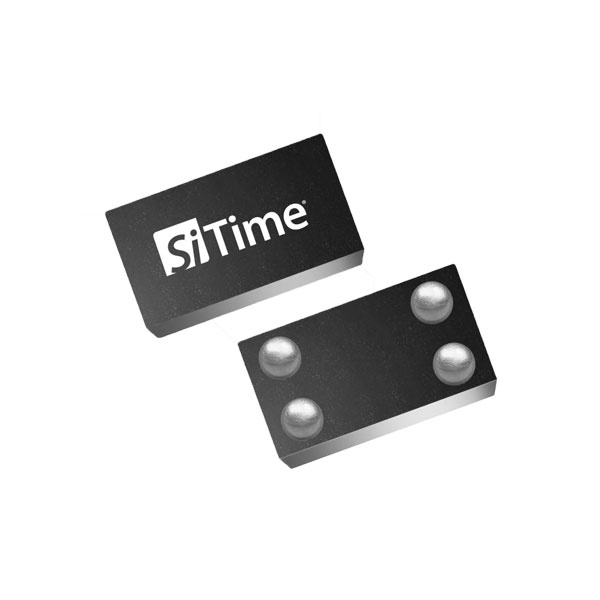
SiT1532 Nano-Drive 32.768 kHz Oscillators: Engineered for wearable devices and IoT sensor nodes, this device operates from 1.2 V to 3.63 V. It consumes less than 1 µA of current. Housed in a chip-scale package measuring 1.5*0.8 mm, it uses 80% less board area than conventional tuning-fork crystals.
SiT8008 Low Power Oscillators: Covering frequencies from 1 MHz to 110 MHz, the SiT8008 delivers frequency stability as tight as ±20 PPM. It operates from -40 to +85°C with programmable drive strength, allowing engineers to reduce electromagnetic emissions.
SiT9505 Ultra-Low Jitter Differential Oscillators: Designed for 100G/200G/400G/800G optical modules and data-center networking equipment, this device achieves typical RMS phase jitter of 41 fs. It supports LVPECL, LVDS, and HCSL outputs across 2.0×1.6 / 2.5×2.0 / 3.2×2.5 mm packages.
SiT5356 Elite Platform Super-TCXO Devices: This device delivers frequency stability down to ±0.1 PPM. It provides exceptional dynamic performance under rapid airflow, thermal shocks, and power supply noise in 5G wireless base stations.
These specifications enable hardware engineers to eliminate complex jitter cleaning circuits, simplifying board layouts and reducing total component count. Programmable output impedance and slew rate control also reduce reflections on high-speed digital traces. By tuning drive strength directly within the oscillator, engineers eliminate external damping resistors and improve eye diagram margins.
Supply Chain Agility: Rapid Blank Programming and Lead Time Compression
A persistent challenge in quartz timing procurement is long factory manufacturing lead times. Each quartz crystal frequency requires custom physical blank cutting, angle lapping, and electrode plating. This mechanical process extends lead times to sixteen to twenty-four weeks during market crunches. SiTime MEMS oscillators resolve this supply bottleneck through distributor-level field programmability. Standard unprogrammed silicon blanks are manufactured in volume and stocked at authorized distribution centers. Technicians program blanks to exact frequencies, operating voltages, and output configurations using automated programming equipment.
To support immediate production requirements, YQM stocks extensive blank inventory across dedicated logistics hubs. With automated programming benches, our technicians program, tape, and ship customized sample batches within forty-eight hours, compressing standard delivery cycles. Distributor-level programming also eliminates custom frequency tooling charges and high minimum order quantities. Engineering teams can order small prototype batches of specialized frequencies with the exact same lead time as standard catalog frequencies. This programming architecture provides massive risk mitigation against project specification revisions. If a microcontroller clock requirement shifts late in the design cycle, technicians reprogram the same inventory blanks without waiting for new factory production runs.
Application Architecture: High-Speed Networking and Edge Computing Integration
Integrating MEMS timing devices into complex computing hardware yields significant architectural and operational benefits across demanding system designs.
Elimination of External Load Capacitors: Unlike passive quartz resonators that require matched external load capacitors, MEMS oscillators integrate internal feedback circuitry and output buffers. This eliminates external passive components, reduces PCB trace routing complexity, and prevents parasitics.
Immunity to Power Supply Noise and EMI: MEMS oscillators incorporate internal low-dropout voltage regulators and differential amplifier circuits. This internal filtering minimizes power supply ripple sensitivity, preventing clock jitter in noisy server power domains.
Drop-In Footprint Compatibility: SiTime oscillators use standard 2016, 2520, 3225, and 7050 package footprints. Engineers can replace unreliable quartz oscillators directly without redesigning the PCB layout.
Flexibility in Multi-Voltage Architectures: MEMS oscillators support continuous operating voltages between 1.8 V and 3.3 V without component changes. This flexibility simplifies component qualification and bill of materials management across diverse board designs.
These integration advantages allow design teams to meet tight product development deadlines while improving finished system reliability. For ruggedized edge AI boxes, shock tolerance is paramount. MEMS oscillators maintain locked clock frequencies when mounted beside high-speed cooling fans, motors, and automotive chassis components where quartz resonators unlock.
Securing Silicon Timing for Next-Generation Hardware
Transitioning to silicon MEMS timing devices protects mission-critical electronic equipment against mechanical vibration, thermal instability, and supply chain delays. Authorized franchised distribution gives engineering teams access to verified factory components, automated custom programming, and substantial inventory reserves. By eliminating quartz fragility and compressing lead times from months to days, authorized MEMS distribution delivers superior technical and commercial confidence.
Explore certified SiTime timing solutions, request custom programmed samples, and view spot stock availability directly through the official portal: https://www.yqmec.com/
About Us YQM ELECTRONICS INTL LIMITED
Headquartered in Shenzhen, China, YQM ELECTRONICS INTL LIMITED is a trusted distributor of cost-effective electronic components. Our comprehensive portfolio spans frequency control, timing, sensors, inductors, connectors, discrete components, and filters.
We serve global enterprises across the industrial, datacom, consumer electronics, and medical sectors, helping accelerate time-to-market through expert technical support, component selection, and tailored solutions.
As an authorized distributor for leading international and domestic brands—including EPSON, SiTime, Honeywell, Sunlord, XKB, CJT, NCE, Blue Rocket, and UTC—we enrich customer design options and simplify procurement. Guided by our “”demand-driven product sourcing”” philosophy, YQM bridges global markets to make component circulation seamless, transparent, and cost-efficient.
Media Contact
Company Name: YQM ELECTRONICS INTL LIMITED
Contact Person: Media Relations
Email: Send Email
Country: China
Website: https://www.yqmec.com
Press Release Distributed by ABNewswire.com
To view the original version on ABNewswire visit: Global SiTime MEMS Oscillator Distributor Supply Analysis for Next-Generation Timing Designs
