Shunyi, Beijing, China – October 15, 2026
By 2026, the thermal and night vision market feels a lot more specialized, more measurable, and honestly, more demanding. Buyers aren’t just glancing at specs anymore. They’re comparing image clarity, sensor stability, battery endurance, export documentation, and after-sales support. Grand View Research reported that the global thermal imaging market was worth roughly USD 4.04 billion in 2023. It also projected steady growth through 2030, helped along by industrial inspection, public safety, transportation, and outdoor observation applications. MarketsandMarkets sees a similar trend, noting rising demand for compact sensors, digital night vision, and integrated imaging platforms.Performance is what matters in real conditions. A device might promise long detection distances, but fog, rain, reflective surfaces, and human movement can cut practical results down fast. FLIR Systems, HIKMICRO, Teledyne FLIR, Pulsar, and AGM Global Vision each take different approaches to sensor quality, software integration, ergonomics, and pricing. So it’s worth comparing their products through verified specifications, independent testing, warranty terms, and regional service availability. Shortlist carefully.This guide looks at leading products for global buyers in 2026. It focuses on lawful civilian, industrial, environmental, security, and professional observation uses. International purchasing also means paying attention to customs rules, product certifications, privacy requirements, and destination-country regulations. A specification table can’t show every field condition, and that limitation deserves some honesty. We may still miss important differences without hands-on testing. So the rankings here should support informed evaluation, not replace professional advice, local compliance checks, or direct product trials.
 Definition and Role of Thermal and Night Vision Devices
Thermal and night vision devices convert invisible environmental information into usable images. Thermal devices detect heat differences, even in darkness, light fog, or dense vegetation. Night vision devices amplify available light, producing a green or monochrome image. They need some ambient light, unless paired with an approved infrared illuminator. The distinction matters. A warm person may stand out thermally, while night vision can reveal clothing details more naturally.
Their role extends beyond observation. Professionals use these systems for lawful search and rescue, wildlife monitoring, industrial inspection, perimeter safety, and navigation. MarketsandMarkets reported that the thermal imaging market could grow from approximately USD 4.8 billion in 2023 to USD 6.6 billion by 2028. Fortune Business Insights estimated the global night vision device market at about USD 7.1 billion in 2023. These figures indicate sustained demand, but forecasts remain sensitive to technology costs and regional regulations.
Practical selection requires more than resolution.Sensor sensitivity, refresh rate, battery life, weather sealing, field of view, and image latency affect real performance. A specification sheet can mislead. A high pixel count cannot compensate for poor calibration or weak software. Buyers should request test footage, verify measurement accuracy, and check import, privacy, and outdoor-use rules. Thermal images may look impressive on a screen, yet poor focus can hide critical details. That is an easy mistake. Reported market growth also does not guarantee equal product quality across suppliers.
How Thermal Imaging and Night Vision Technologies Work
Thermal imaging and night vision do not “see in the dark” in the same way. Thermal sensors detect infrared energy emitted by objects, usually in the long-wave infrared band. A warm hand appears against a cooler wall because temperature creates contrast. Emissivity matters, however. Wet glass, polished metal, smoke, and dense rain can distort readings. A thermal camera may reveal a heat source without showing its true color or surface detail.Night vision works differently. It gathers limited visible and near-infrared photons, then amplifies them through a photocathode, a microchannel plate, and a phosphor display. Good starlight can produce detailed outlines. Complete darkness still requires suitable illumination. Resolution, gain control, noise, and halo effects shape the image. The result can look clear while hiding important distance errors. Numbers need context.Grand View Research estimated the global thermal imaging market at about USD 4.1 billion in 2023, with continued growth through 2030. Its night vision device research also identified sustained demand across security, industrial inspection, and transportation. These figures show market momentum, not automatic product quality. Buyers should compare NETD, spectral range, detection distance, refresh rate, sensor resolution, and measured performance in rain or fog. A lower NETD often supports finer temperature differences, but testing methods vary. I would not trust one specification sheet alone. Actual scenes are messier. Selection must also follow local privacy, import, and equipment-use laws.
2026 Top Thermal and Night Vision Devices for Global Buyers
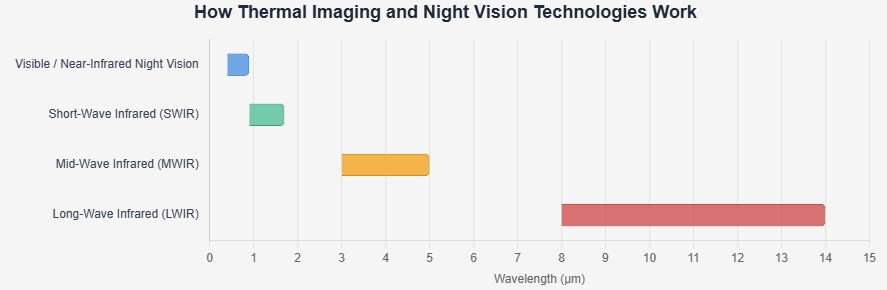
Thermal imaging detects emitted infrared radiation, while night vision typically amplifies available visible and near-infrared light. The chart shows common spectral operating bands used by these technologies.
Key Device Types for Different Global Applications2026 Top Thermal and Night Vision Devices for Global BuyersKey Device Types for Different Global Applications
Thermal monocularssuit wildlife surveys, utility checks, and search support in low-visibility areas. They detect heat rather than reflected light. This helps users identify warm machinery behind light smoke or dense vegetation. Select resolution, detection range, battery life, and weather protection for the working environment. A compact model may be easier to carry, but its image can lose detail at distance.
Thermal camerasprovide broader coverage for facilities, ports, farms, and industrial maintenance. Fixed units can monitor heat patterns around electrical panels, pipelines, and storage areas. Handheld cameras work better during inspections across large sites. Look for reliable calibration, clear temperature measurements, and suitable IP protection. A high specification does not guarantee useful results. Installation angle and operator training matter greatly.
Night vision devicesamplify available light, while digital night vision uses sensors and infrared illumination. They can support lawful observation, navigation, environmental research, and emergency coordination. Choose binoculars for extended viewing and monoculars for lighter field work. Infrared illumination may improve visibility, yet it can reduce battery life.
Test performance under real conditions, including rain, glare, and complete darkness. Some devices appear impressive indoors but disappoint across open ground. Buyers should verify warranty terms, service access, data privacy requirements, and import rules in each destination. Field needs often change after purchase, which is an uncomfortable but common planning mistake.
Essential Performance Specifications for Buyer Comparison
For 2026 buyers, performance specifications matter more than impressive product images.Grand View Research estimates the global thermal imaging market will expand at about 7% annually through 2030. That growth increases product variety, but comparison remains difficult. Start with thermal resolution, NETD, refresh rate, and lens choice. A 640×512 sensor reveals finer heat patterns than a 256×192 sensor. NETD below 35 mK can separate small temperature differences in damp or cluttered scenes. Lower is usually better.
Detection range needs careful interpretation.Manufacturers may quote recognition distances under ideal conditions. Fog, rain, reflective surfaces, and warm backgrounds reduce real performance. Buyers should request detection, recognition, and identification figures under the same test method. The European Association of Remote Sensing Companies emphasizes standardized evaluation for reliable thermal measurements. A long range claim is not a decision.
For night vision devices, compare image intensifier sensitivity, signal-to-noise ratio, resolution, gain control, and infrared illumination options.The U.S. Department of Energy reports that low-light imaging performance depends heavily on ambient illumination and optical efficiency. Digital systems may offer recording and sharper daytime images, yet battery demand can rise quickly. Field testers should inspect moving branches, facial detail, and edge clarity at several distances. Do not trust one showroom demonstration. My own comparison framework would also record temperature, humidity, and battery age, although many purchasing teams skip these details. That omission can distort results. Weight, eye relief, weather sealing, and warranty support deserve equal attention. Specification sheets rarely show the whole experience.
International Standards, Regulations, and Export Considerations2026 Top Thermal and Night Vision Devices for Global BuyersInternational Standards, Regulations, and Export Considerations
Demand is expanding beyond security. MarketsandMarkets’ 2024 Thermal Imaging Market report projects growth from about USD 6.5 billion in 2024 to USD 9.2 billion by 2029. Grand View Research also identifies industrial inspection, transport, and public safety as major application areas. These figures show opportunity, but not automatic market access.
Compliance begins with technical details. Buyers should verify wavelength, detector resolution, refresh rate, temperature range, and recording functions. IEC 60529 ratings clarify dust and water protection. IEC 61000 testing supports electromagnetic compatibility. RoHS and REACH requirements may apply to electronic products sold in Europe. A certificate alone is not enough.
Export review needs equal attention. Classification can depend on performance, software, encryption, destination, and intended use. The EU Dual-Use Regulation 2021/821 and the Wassenaar framework may affect selected high-performance equipment. Other jurisdictions apply separate export-control rules and sanctions screening. Keep end-user statements, invoices, serial numbers, and technical sheets consistent. Small discrepancies create delays.
We still see buyers checking price first. That is a costly habit. Independent laboratory reports are useful, but they cannot replace local legal advice. Regulations change. Recheck them before shipment.
How to Select Reliable Thermal and Night Vision Equipment
How to Select Reliable Thermal and Night Vision EquipmentChoosing reliable thermal and night vision equipment requires more than comparing prices. Start with the intended environment, viewing distance, and weather conditions. Thermal devices detect heat differences, while night vision needs available light or infrared illumination. A device may perform well outdoors but struggle near reflective glass, heavy rain, or dense foliage. Check image resolution, detection range, refresh rate, and battery performance. Independent test results are more useful than dramatic advertising claims. Look for clear technical specifications and a practical warranty.Tips: Ask for sample images from real operating conditions. Test controls while wearing gloves. Confirm the device’s IP rating for dust and water resistance. Check whether replacement batteries are available in your region. Verify local laws before purchasing or using any optical equipment. Avoid sellers who hide export restrictions, safety information, or return terms. Professional support should explain limitations, not promise perfect visibility.A dependable unit should feel balanced in the hand and remain usable after several hours. Inspect focus adjustment, screen brightness, mounting options, and menu clarity. Thermal sensitivity matters, but it does not replace careful observation. Night vision quality can change sharply with surrounding light. I have found that published range figures often assume ideal weather and a large target. Real scenes are less cooperative. Firmware updates, service access, and data protection also deserve attention. Keep purchase records and test the equipment within the return period.
2026 Top Thermal and Night Vision Devices for Global Buyers – How to Select Reliable Thermal and Night Vision Equipment
| Device Category | Core Imaging Technology | Typical Resolution | Typical Spectral or Sensitivity Range | Typical Detection Distance* | Recommended Use | Key Reliability Checks | Buyer Suitability |
|---|---|---|---|---|---|---|---|
| Compact Thermal Monocular | Uncooled long-wave infrared microbolometer | 256 × 192 to 384 × 288 pixels | 8–14 μm; NETD commonly ≤35–50 mK | Approximately 600–1,200 m for human-size target detection, depending on lens and weather | Outdoor observation, hiking, wildlife monitoring, basic security patrols | Uniformity calibration, sealed housing, battery protection, operating temperature rating, refresh-rate stability | Best for portability and moderate budgets |
| Professional Thermal Monocular | Uncooled long-wave infrared microbolometer with advanced image processing | 384 × 288 to 640 × 512 pixels | 8–14 μm; NETD commonly ≤18–35 mK | Approximately 1,000–2,500 m for human-size target detection, subject to optics and atmospheric conditions | Perimeter security, search and rescue, industrial inspection, professional field work | Detector uniformity, image latency, focus mechanism, optical distortion, ingress protection, serviceability | Best balance of detail, range, and field durability |
| Thermal Clip-On Module | Uncooled long-wave infrared sensor designed to mount in front of a daylight optical system | 384 × 288 or 640 × 512 pixels | 8–14 μm; NETD commonly ≤25–35 mK | Approximately 800–2,000 m for human-size target detection, depending on host optics | Rapid conversion of existing optical equipment for low-visibility observation | Mounting repeatability, optical-axis alignment, zero retention, added weight, waterproofing, compatibility testing | Best when existing daytime optics must be retained |
| Fixed Thermal Security Camera | Uncooled long-wave infrared sensor with continuous video output | 384 × 288, 640 × 512, or higher | 8–14 μm; NETD commonly ≤35–50 mK | Approximately 500–3,000 m for detection, depending on lens, mounting height, and target size | Perimeter surveillance, critical infrastructure, ports, utilities, and industrial sites | ONVIF or equivalent interoperability, weather rating, surge protection, continuous-operation test, network security | Best for permanent monitoring systems |
| Digital Night Vision Monocular | Low-light CMOS or scientific-grade digital image sensor with infrared illuminator support | Typically 1280 × 720 to 1920 × 1080 pixels | Visible and near-infrared; often usable from approximately 0.001–0.01 lux with suitable illumination | Approximately 150–500 m in low light; infrared-assisted distance varies with illuminator power and beam angle | Recreational observation, property monitoring, navigation, and recording | Sensor performance in near darkness, infrared wavelength compatibility, video compression, battery life, firmware support | Best for recording and flexible daytime/nighttime use |
| Image-Intensified Night Vision Device | Gen 2 or Gen 3 image intensifier with photocathode, microchannel plate, and phosphor screen | Effective image detail is commonly specified by resolution in line pairs per millimetre; approximately 45–72 lp/mm is typical for modern high-performance systems | Visible to near-infrared response; approximately 400–900 nm, depending on photocathode design | Approximately 200–600 m under suitable moonlight or starlight; atmospheric conditions strongly affect performance | Professional low-light observation where natural-light sensitivity and low display latency are priorities | Signal-to-noise ratio, halo size, equivalent background illumination, blemish limits, automatic brightness control, tube documentation | Best for demanding passive night observation |
| Fusion Thermal and Night Vision Viewer | Thermal sensor combined with digital or intensified low-light channel | Thermal channel commonly 384 × 288 or 640 × 512; low-light channel commonly 1280 × 720 or higher | Thermal: 8–14 μm; low-light: visible to near-infrared | Approximately 500–2,000 m for human-size target detection, depending on the selected channel and optics | Search and rescue, security response, navigation, and complex environments with mixed lighting | Channel alignment, switching speed, image-fusion accuracy, independent focus control, power consumption, software reliability | Best for users requiring multiple observation modes |
| Thermal Handheld Inspection Camera | Uncooled long-wave infrared sensor with radiometric temperature measurement | 160 × 120 to 640 × 480 pixels | 8–14 μm; typical measurement accuracy around ±2 °C or ±2%, subject to specified conditions | Close to medium range; measurement accuracy depends on distance, emissivity, and field of view | Electrical maintenance, mechanical inspection, building diagnostics, and HVAC assessment | Calibration traceability, emissivity adjustment, reflected-temperature correction, measurement repeatability, data export | Best for maintenance and temperature diagnostics |
Selection note: Detection distance is an indicative engineering range for identifying a human-size target, not a guaranteed recognition or identification distance. Actual performance varies with lens focal length, target size, humidity, rain, fog, temperature contrast, movement, image processing, and mounting conditions. For international procurement, request an environmental test report, calibration record, ingress-protection rating, operating-temperature specification, warranty terms, spare-parts availability, and compliance documentation before purchase.A Practical Guide to Radifeel Cooled Handheld Thermal Binoculars – MHB Series
Radifeel Cooled Handheld Thermal Binoculars -MHB series
For teams selecting cooled handheld thermal binoculars, the MHB series offers a practical combination of reach, clarity, and all-weather usability. Its medium-wave 640×512 detector is designed to preserve image detail across long observation distances, while the 40–200 mm continuous-zoom lens enables smooth transitions from broad-area scanning to precise target inspection. This configuration is particularly useful for border observation, coastal monitoring, infrastructure patrols, and public-safety missions where conditions may change quickly.Industry demand supports the move toward higher-resolution, cooled thermal systems. The MarketsandMarkets *Thermal Imaging Market* report published in 2024 projected continued growth in the sector through 2028, driven by defense, security, industrial inspection, and transportation applications. In practice, buyers should assess not only detector resolution but also sensitivity, zoom continuity, stabilization, battery endurance, and performance in haze, darkness, and changing weather. A visible-light channel can add contextual detail, while integrated laser ranging helps operators estimate distance more consistently without relying solely on visual judgment.For intelligence collection, landing support, near-air-defense observation, and post-event assessment, the MHB series combines thermal, visible, and ranging functions in one portable platform. Its cooled architecture is suited to extended-distance observation where thermal contrast and fine target separation matter most. Before deployment, organizations should verify environmental ratings, eye-safety compliance, data-security controls, training requirements, and compatibility with their lawful operating procedures.
Conclusion
Thermal and Night Vision Devices are essential tools for improving visibility and situational awareness in darkness, low light, fog, smoke, and changing environmental conditions. Thermal imaging detects heat differences, while night vision amplifies available light to create a clearer image. This article explains their roles, operating principles, and major device types, including handheld viewers, mounted systems, observation equipment, and solutions for industrial, security, outdoor, marine, and emergency applications.For global buyers, careful comparison of detection range, image resolution, refresh rate, sensitivity, battery life, durability, weather resistance, and ease of use is essential. The guide also highlights the importance of international standards, product certifications, import and export requirements, user safety, and responsible application. By evaluating technical performance, operating conditions, supplier reliability, warranty support, documentation, and total ownership costs, buyers can select dependable Thermal and Night Vision Devices that meet their specific needs while supporting lawful and compliant international procurement.
About Us
Beijing Radifeel Technology Co., Ltd.
Radifeel Technology, headquartered in Beijing, is a dedicated solution provider of various thermal imaging and detection products and systems with strong capability of design, R&D and manufacture.
Media Contact
Company Name: Beijing Radifeel Technology Co., Ltd.
Contact Person: Media Relations
Email: Send Email
Country: China
Website: https://www.radifeel.com/
Press Release Distributed by ABNewswire.com
To view the original version on ABNewswire visit: 2026 Top Thermal and Night Vision Devices Gain Global Market Attention