Key Takeaways
- A Class A ASTM E108 rating measures how turf performs under a specific fire test; it does not make the material fireproof or immune to melting from sustained heat
- Class A-rated turf can still melt, burn, or sustain heat damage, so grills, fire pits, and heaters should be kept away from synthetic grass and placed on suitable noncombustible surfaces.
- Rooftop and deck turf installations need to account for structural weight, drainage, and roofing membrane compatibility alongside any fire requirements
- Homeowners near wildfire-prone land should treat fire-rated turf as one part of a broader defensible-space plan, not a full substitute for it
- Knowing what questions to ask about a fire-performance claim can reveal whether a product was actually tested for the application it is being sold for
San Diego’s mix of coastal breezes, dry canyons, and wildfire-prone backcountry makes fire safety a real factor in choosing a lawn replacement, rather than a box to check. Homeowners researching artificial turf often run into the term “Class A fire rated” and assume it means the product can’t burn or melt. That assumption can lead to risky choices around fire pits, grills, and properties near open space.
Fire-Rated vs. Standard Artificial Grass: What San Diego Homeowners Need to Know
Wildfire safety is an important consideration for homeowners throughout San Diego and Southern California. Whether your property is located near a canyon, hillside, or designated wildfire hazard area, choosing appropriate landscaping materials can play a role in protecting your home and creating a more fire-conscious outdoor environment.
One question homeowners may have when researching wildfire-resistant landscaping is whether fire-rated artificial turf offers advantages over standard artificial grass.
The answer depends on the product’s documented fire performance, construction, installation requirements, and how the material fits into your overall landscape design.
At SYNLawn San Diego, we offer qualifying Class A fire-rated artificial turf systems that provide additional options for property owners evaluating fire-resistant artificial grass.
However, fire-rated does not mean fireproof. Understanding that distinction is especially important as San Diego homeowners navigate wildfire safety recommendations and defensible-space requirements.
Here’s what you should know before choosing artificial grass for your property.
Why Fire-Resistant Landscaping Matters in San Diego
San Diego’s dry climate, seasonal Santa Ana winds, and proximity to natural vegetation make wildfire preparedness an important consideration for many property owners.
Homes near hillsides, canyons, and open spaces may be exposed to wind-driven embers, radiant heat, and approaching flames during wildfire events.
Wildfire-resistant landscaping focuses on reducing combustible materials, limiting potential ignition sources, and creating defensible space around buildings.
Common strategies include incorporating noncombustible hardscaping, maintaining vegetation, removing dead landscaping materials, and selecting outdoor products with appropriate performance characteristics.
Artificial grass may be considered as part of a broader fire-conscious landscape design where permitted. However, synthetic turf is manufactured from materials that can react to heat and flame.
While artificial turf does not dry out like natural vegetation, it should never be assumed to be noncombustible.
For homeowners researching fire-safe landscaping in San Diego, understanding the specific fire-performance characteristics of their artificial grass is essential.
Fire-Rated vs. Standard Artificial Grass: What’s the Difference?
Not all artificial turf products offer the same fire-performance characteristics.
Some artificial grass systems undergo recognized testing to evaluate how they respond to external fire exposure. Others are designed primarily for appearance, drainage, durability, and general landscape applications without a documented Class A fire classification.
Class A Fire-Rated Artificial Turf
Class A fire-rated artificial turf systems have documented performance under specified fire-testing conditions.
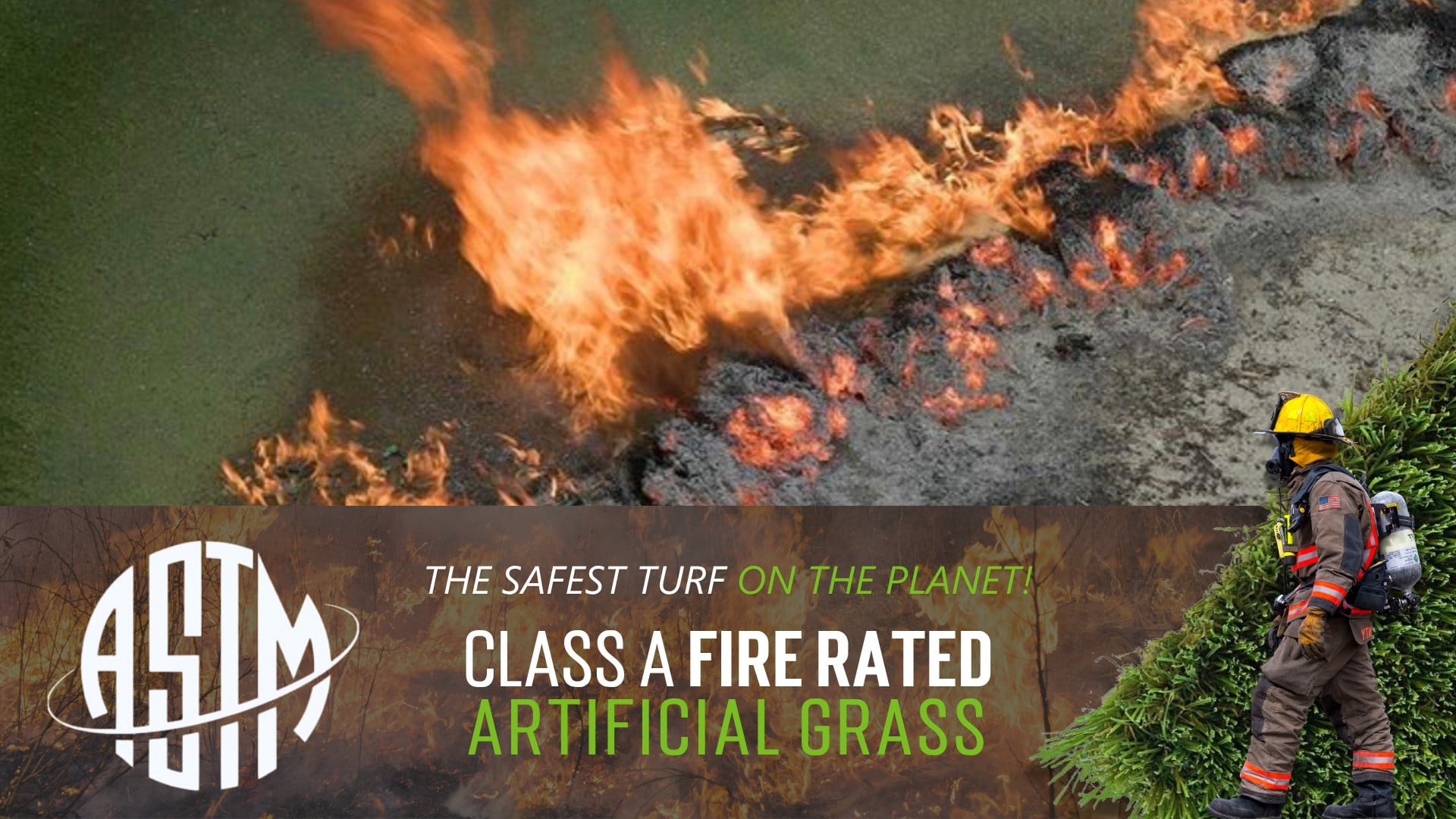
When a qualifying turf system has been evaluated under ASTM E108 and achieves a Class A classification, the results provide information about its response to severe external fire-test exposure.
For San Diego homeowners considering fire-resistant artificial grass, this documentation provides another factor to evaluate when comparing synthetic turf products.
A Class A fire rating does not mean the material cannot ignite, melt, sustain heat damage, or burn under real-world wildfire conditions.
The classification applies to the specific system and configuration tested, not automatically to every artificial grass product or installation.
Standard Artificial Grass
Standard artificial turf is generally selected based on features such as realistic appearance, softness, fiber resilience, drainage capabilities, and suitability for particular uses.
While these products may perform well as residential or commercial landscaping materials, they do not necessarily have documented Class A fire-performance classifications.
Standard artificial grass also varies in construction. Yarn composition, backing materials, infill, and installation methods can all influence how a product responds to heat and fire exposure.
Homeowners should not assume that all artificial grass products offer equivalent fire resistance.
Why This Difference Matters
For properties in areas with wildfire exposure, documented fire-test results can be an important product-selection consideration.
Qualifying Class A fire-rated artificial turf systems provide independently evaluated performance information that may be relevant to a fire-conscious landscaping plan.
However, neither standard nor Class A fire-rated artificial grass is automatically approved for every wildfire hazard zone or defensible-space application.
The complete landscape design and applicable local requirements remain essential.
What Does ASTM E108 Class A Fire-Rated Artificial Turf Mean?
ASTM E108 is a recognized testing standard developed to evaluate the fire performance of roof-covering systems exposed to external fire conditions.
The standard establishes different classifications based on specific testing procedures.
Class A represents performance under severe external fire-test exposure.
Class B addresses moderate external fire-test exposure.
Class C addresses lighter external fire-test exposure.
Class A is the highest classification within this standard.
However, ASTM E108 evaluates specific tested assemblies and does not establish that a material is noncombustible or wildfire-proof.
For artificial turf products, the tested configuration is especially important. Product backing, underlying materials, infill where applicable, and installation details may affect whether a particular classification applies.
Homeowners should ask for current product documentation and determine whether the proposed installation matches the manufacturer’s tested system.
It’s also important not to confuse ASTM E108 with other fire-performance standards, which can evaluate different characteristics under different testing conditions.
A Class A fire rating is evidence of performance under a defined test, not a guarantee of protection against every wildfire scenario.
Can Artificial Turf Be Installed in California Wildfire Hazard Zones?
Artificial grass may be allowed in certain California wildfire hazard areas, but installation requirements depend on the property’s location, proximity to structures, building characteristics, and applicable regulations.
California’s defensible-space framework is intended to reduce potential fuel sources and limit the spread of fire toward buildings.
For homeowners considering artificial grass in wildfire zones, the location of the installation is particularly important.
Turf installed in an open landscape area may be subject to different considerations from turf installed directly against a home, deck, or staircase.
Fire-rated artificial turf does not automatically qualify for use in every location.
Before proceeding with an installation, homeowners should verify the requirements established by their local building and fire authorities.
Understanding San Diego’s 2026 Zone 0 and Defensible-Space Requirements
One of the most important considerations for fire-safe landscaping in San Diego is Zone 0, the area extending from a building’s exterior walls to approximately five feet away.
Often called the ember-resistant zone, Zone 0 focuses on reducing combustible materials immediately surrounding structures.
Wind-driven embers can accumulate near walls, decks, landscaping materials, and other exterior features, creating potential ignition hazards.
As a result, noncombustible materials such as gravel, concrete, and pavers are emphasized in Zone 0 planning.
Can Artificial Turf Be Installed Within Five Feet of a Home?
The City of San Diego’s April 2026 Zone 0 guidance for existing structures addresses artificial turf and grass lawns.
For certain qualifying existing structures without ignition-resistant construction features, the guidance identifies a minimum two-foot separation between artificial turf or grass lawns and structure walls, decks, and stairs.
However, this provision is not a blanket approval for every artificial grass installation.
The rules that apply can depend on the building’s characteristics, the property’s wildfire hazard designation, and the relevant local authority.
The City’s published guidance identifies February 28, 2026, for new structures and February 28, 2027, for existing structures within its covered Very High Fire Hazard Severity Zones.
Unincorporated San Diego County has its own defensible-space guidance emphasizing noncombustible materials within the first five feet around structures.
Because applicable requirements may differ by jurisdiction and property, homeowners should confirm current rules before making final landscaping decisions.
Important: ASTM E108 Class A fire-rated turf should not be treated as a substitute for required noncombustible materials, appropriate separation distances, or defensible-space maintenance.
SYNLawn’s Class A Fire-Rated Artificial Turf Options
At SYNLawn San Diego, we understand that homeowners want landscaping products that combine attractive appearance, durability, and appropriate performance characteristics.
SYNLawn offers specialized nylon-based artificial turf systems with documented ASTM E108 Class A fire ratings, including qualifying products within its SYNRye collection. Options such as SYNRye 200 and SYNRye 247 demonstrate the range of artificial grass solutions available for projects where documented fire performance is an important consideration. SYNLawn also offers qualifying nylon-based golf surfaces for custom putting greens and specialized recreational applications. Because fire classifications apply to specific tested systems, homeowners and commercial buyers should request current documentation for the exact turf product and proposed installation.
Our Fire Safety Benefits page provides additional information about our approach to artificial grass fire performance and available product technologies.
SYNLawn’s turf portfolio incorporates specialized yarn materials, backing systems, and technologies designed for different applications.
However, not every SYNLawn product has the same fire rating.
When selecting Class A fire-rated artificial turf, customers should confirm the exact product and tested configuration rather than assuming a classification applies to all synthetic grass options.
Our team can help homeowners explore available products and discuss installation considerations for their specific landscapes.
Where Does Fire-Rated Artificial Turf Make Sense?
Fire-rated artificial turf can be an important consideration for various residential and commercial landscaping applications where documented fire performance is relevant.
Residential lawns
For homeowners near canyons, hillsides, or wildfire-prone vegetation, fire-rated turf may be worth evaluating alongside other landscaping materials.
However, any installation must work within the property’s applicable defensible-space requirements.
Fire-conscious landscape design should also include appropriate hardscaping, vegetation management, and regular removal of combustible debris.
Backyard putting greens
A custom backyard putting green can provide a convenient outdoor practice area without the routine mowing or watering required for natural putting surfaces.
For properties in wildfire hazard areas, the fire-performance characteristics of the putting surface and surrounding fringe may be additional product-selection considerations.
Each turf component should be evaluated according to its individual specifications.
Rooftops and elevated outdoor spaces
Rooftop artificial grass installations require special attention to structural loading, drainage, waterproofing, and applicable fire requirements.
A qualifying Class A tested system may be relevant to the project, but the complete rooftop assembly must satisfy applicable building and fire codes.
A turf product’s rating alone does not establish compliance for an entire rooftop installation.
Commercial landscaping
Hotels, apartment communities, office properties, schools, and other commercial spaces may benefit from reviewing documented fire-performance information when selecting artificial turf.
Commercial projects may also require specifications established by architects, building officials, insurers, or property management teams.
Explore our commercial artificial grass solutions to learn more about available applications.
How to Choose Artificial Grass for a Fire-Conscious Landscape
Selecting the right turf for wildfire-resistant landscaping requires more than choosing a product advertised as fire-resistant.
Homeowners should consider the intended location, applicable wildfire regulations, product testing, and complete installation design.
Verify the product’s fire classification
Ask whether the artificial grass system has documented ASTM E108 Class A test results.
Review the supporting information to determine which products and installation configurations are covered.
Evaluate the installation location
Determine whether the proposed turf area falls within Zone 0 or another regulated defensible-space area.
The distance from buildings, decks, stairs, and other exterior features can affect the requirements.
Consider surrounding landscape materials
Artificial grass should be evaluated as one component of a larger landscaping plan.
Noncombustible hardscaping, maintained vegetation, and appropriate separation between combustible materials remain important.
Choose an experienced turf installer
Working with knowledgeable artificial grass installers in San Diego can help homeowners understand product options and installation considerations.
The contractor should be able to explain the proposed turf materials, base preparation, drainage design, and relevant documentation.
Maintain the landscape after installation
Artificial turf requires ongoing care, particularly where combustible debris can accumulate.
Removing dry leaves, pine needles, and other debris can help reduce unnecessary fuel accumulation around the property.
Routine cleaning and inspection remain important even when fire-rated products are installed.
Frequently Asked Questions About Fire-Rated Artificial Turf
Is fire-rated artificial turf fireproof?
No. Fire-rated artificial turf is not fireproof. A Class A classification describes performance under specified fire-testing conditions and does not guarantee that the material will withstand an actual wildfire.
What is the difference between fire-resistant and fire-rated artificial grass?
Fire-resistant is a general description that may refer to a material’s response to heat or flame. Fire-rated artificial grass has documented performance under a specific testing standard. Buyers should review the actual test classification and supporting documentation.
Does SYNLawn offer Class A fire-rated artificial grass?
Yes. SYNLawn offers qualifying artificial turf systems with documented ASTM E108 Class A fire ratings such as SYNRye 200, SYNRye 247, and others. Individual product specifications and testing documentation should be verified before selecting a system.
Can artificial turf be installed within five feet of a house in San Diego?
It depends on the property and applicable local rules. San Diego’s 2026 Zone 0 guidance addresses artificial turf in certain circumstances, including separation requirements for qualifying existing structures. Homeowners should confirm requirements with the appropriate local authority.
Is artificial grass suitable for wildfire-resistant landscaping?
Artificial grass may be included in a wildfire-conscious landscape where permitted. However, synthetic turf is not inherently noncombustible, and installing it does not replace defensible-space requirements.
Does a Class A fire rating mean artificial grass is approved in Zone 0?
No. A Class A rating does not automatically mean a product is approved for installation within Zone 0. Local regulations, building characteristics, and site-specific installation requirements must also be considered.
Is artificial turf safer than dry natural grass during a wildfire?
Dry natural vegetation can contribute to wildfire fuel loads, but synthetic turf can also respond to heat and flame. The relative hazard depends on product materials, site conditions, nearby fuels, and fire exposure. Neither surface should be assumed to provide universal wildfire protection.
Explore Fire-Rated Artificial Grass with SYNLawn San Diego
When choosing artificial grass for your home or commercial property, understanding the differences between standard turf and fire-rated systems can help you make a more informed investment.
For homeowners concerned about wildfire exposure, documented product testing, defensible-space planning, and proper installation are all important considerations.
At SYNLawn San Diego, we offer premium artificial grass solutions, including qualifying Class A fire-rated turf systems, for a variety of residential and commercial applications.
Our team can help you explore available products, understand their specifications, and plan an installation suited to your property’s needs.
Ready to learn more about fire-rated artificial grass in San Diego?
Visit www.synlawnsandiego.com or call 877-303-8873 to schedule your free design consultation.
SYNLawn San Diego
jamie.neagle@synlawn.com
+1 877 303 8873
7060 Miramar Rd Ste 105
San Diego
CA
92121
United States