Key Takeaways
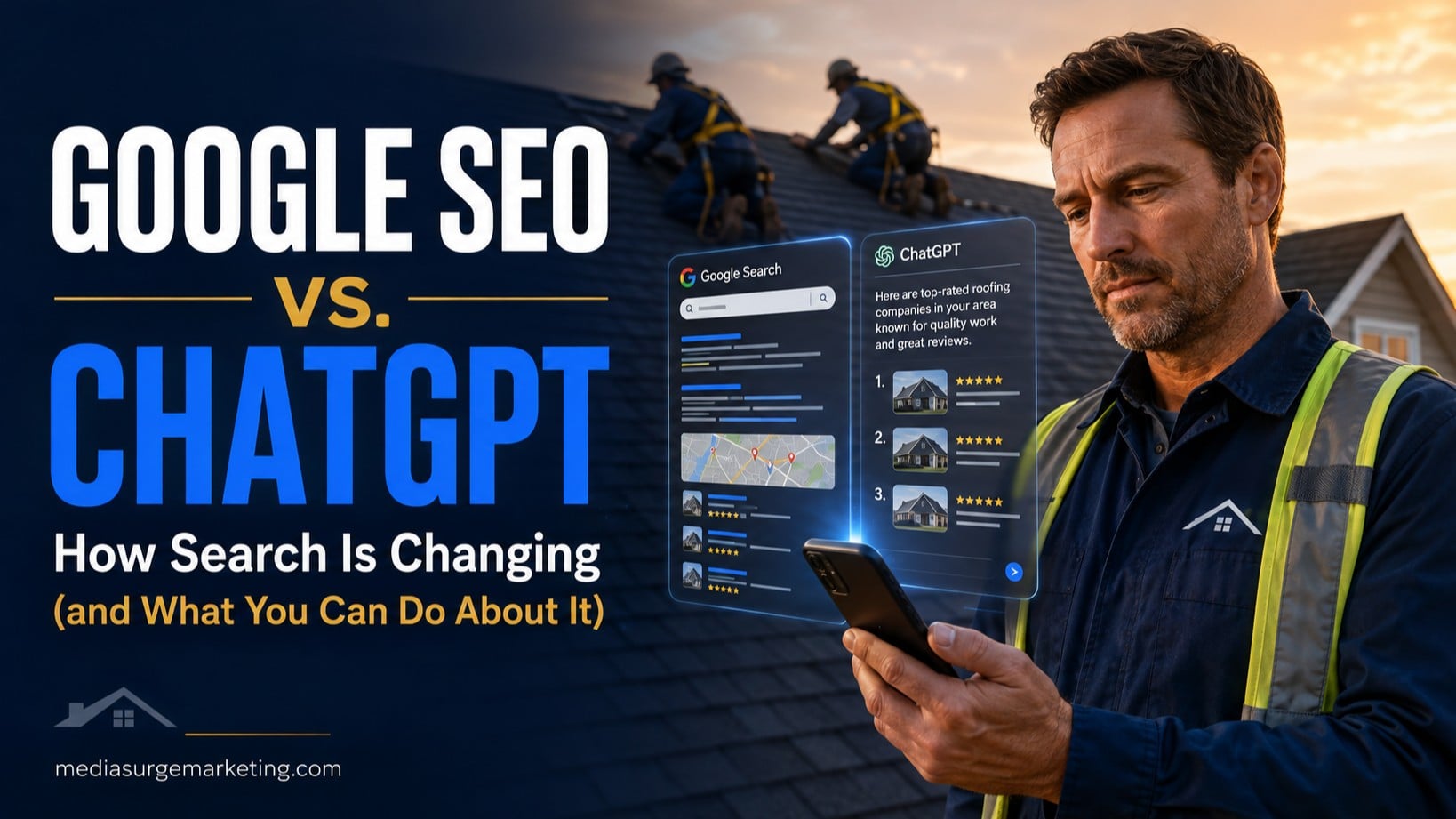
- Google ranks web pages using hundreds of signals – backlinks, page speed, keyword relevance – while ChatGPT primarily synthesizes a single conversational answer from patterns learned during training. Unlike Google, it has no traditional ranking system, though it can use live retrieval and source evaluation when browsing is enabled.
- Studies suggest only a small fraction of URLs cited by ChatGPT overlap with Google’s top-ranked results – meaning strong Google rankings do not guarantee AI visibility.
- Both platforms reward the same core content qualities: expertise, clarity, authority, and trustworthiness — so good SEO remains the foundation; it just needs a broader target.
- The 4 Rs framework – Research, Relevance, Reputation, and Results – offers a practical roadmap for staying visible across both traditional search and AI-generated answers.
- Measuring impressions and brand mentions alongside clicks is becoming essential as AI Overviews quietly decouple traffic from visibility.
The rules of online visibility are shifting – not disappearing. Google and ChatGPT both want to answer your customers’ questions, but the way each platform decides whose answer to surface is fundamentally different. For small business owners, understanding that gap is the difference between being found and being invisible.
Ranking Well on Google Won’t Guarantee You Exist on ChatGPT
Here’s a reality check that surprises most business owners: a website can sit comfortably on Google’s first page and still be completely absent from a ChatGPT response on the same topic. Research into how the two platforms pull information consistently shows a surprisingly small overlap between the URLs ChatGPT cites and the pages Google ranks at the top. That’s not a rounding error – it’s a structural difference in how each platform decides what counts as useful.
This is the kind of visibility gap that Media Surge Marketing’s AI Visibility service was built to address – helping small businesses understand not just where they rank, but whether they actually show up when AI tools answer questions their customers are asking.
The implication is simple but important: treating Google SEO and ChatGPT visibility as the same problem will leave a growing share of potential customers unreached.
Two Platforms, Two Completely Different Engines
Before getting into strategy, it helps to understand exactly what each platform is doing under the hood – because the mechanics drive everything else.
Google: An Index That Ranks
Google is fundamentally a massive index of the web with an AI layer built on top. When someone types a query, Google’s algorithm scans hundreds of signals – the words in the query, the relevance and usability of pages, the expertise of sources, user location, and more – and returns a ranked list of links. The goal is to point users toward the most authoritative, relevant content that already exists on the web.
ChatGPT: A Language Model That Synthesizes
ChatGPT operates differently. By default, it generates a response by predicting the most statistically likely sequence of words based on patterns absorbed during training on a large corpus of web content, books, and other text. When browsing is enabled, it can also retrieve and evaluate live web sources – but even then, the output is a single, synthesized, conversational answer optimized for resolution rather than giving users a list of links to click through.
Think of it this way: Google is a librarian who points you to the best books. ChatGPT is a well-read friend who has already read all of them and just tells you the answer.
Where the Signals Diverge Most
Backlinks and Technical SEO vs. Brand Mentions and Clarity
Google has always relied heavily on backlinks as votes of authority, alongside technical factors such as page speed, mobile-friendliness, and structured data. These signals help Google’s crawlers find, understand, and rank pages.
What influences whether a brand appears in ChatGPT’s synthesized responses is different: how clearly that brand’s expertise is communicated in the content it was trained on, and how consistently the brand is mentioned across credible sources around the web. Traditional keyword stuffing and extensive backlink campaigns – staples of older SEO playbooks – have little bearing on whether an AI language model learns to associate a business with a topic.
A Meaningful Gap in Source Selection Between the Two Platforms
The differences in source selection between Google and ChatGPT are the clearest evidence of how differently these platforms operate. It also points to a practical opportunity: businesses that earn consistent, credible brand mentions across the web – through press coverage, directories, partnerships, and expert citations – are building the exact kind of footprint that AI models learn from. This emerging discipline, sometimes called Generative Engine Optimization (GEO), focuses on making content genuinely useful and widely cited, rather than on technical optimization in the traditional sense.
Where Google and ChatGPT Do Agree
Both Platforms Reward the Same Core Content Qualities
Despite the mechanical differences, both platforms converge on similar content standards. Google uses the E-E-A-T framework – Experience, Expertise, Authoritativeness, and Trustworthiness – explicitly to evaluate content quality. ChatGPT, through its training data and retrieval mechanisms, implicitly favors the same qualities: content that is accurate, clearly written by someone who knows the subject, and cited or referenced in trustworthy places tends to surface more readily in AI responses.
This is the good news for businesses already investing in solid content: the foundation transfers. It just needs to be applied more broadly than a single keyword list.
The Search Landscape Is Already Shifting
AI Overviews and the Great Decoupling of Clicks
Google’s own AI Overviews have introduced a new dynamic: synthesized answers now appear at the very top of many search results pages, before any organic links. A page can earn an impression – its content contributing to the AI summary – without the user ever clicking through to it. Researchers call this the great decoupling of impressions and clicks. Traffic metrics may flatten even as a brand’s actual visibility grows.
ChatGPT Skews Informational; Google Still Leads Commercial Queries
The two platforms also attract different intent. Data shows ChatGPT dominates informational searches – roughly 93.7% of its query mix – while Google maintains strong leadership in navigational and commercial search behavior. Customers asking how to fix a leaky pipe may go to ChatGPT, while customers ready to hire a plumber still largely turn to Google. A smart visibility strategy covers both sides of that intent split.
The 4 Rs: Your Roadmap for Visibility in Both
Research: Use Customer Questions as Your AI Keyword Tool
There’s no ChatGPT equivalent of Google Search Console – no dashboard showing which questions are driving AI responses. The closest substitute is already in hand: the real questions customers ask on the phone, in emails, and during consultations. Those questions closely mirror what people type into AI tools. Test them directly in ChatGPT and observe whose content – or lack thereof – comes back. That gap is the content opportunity.
Relevance: Depth and Expertise Beat Keyword Density
Thin content doesn’t win on either platform anymore. Both Google and ChatGPT favor content that goes deep on a topic, uses real examples, and reflects genuine hands-on expertise. Well-structured FAQs and clear summaries help AI tools extract and synthesize key points. Writing in a natural, conversational tone – the way an expert would explain something to a client sitting across the table – also increases the likelihood that AI models learn to reference that content accurately.
Reputation: Citations and Consistent Brand Mentions Across the Web
This is where the biggest strategic shift lives. Google has always rewarded authority through backlinks. AI models take a broader view: they learn from how often and where a brand is mentioned, described, and cited across the web. Guest posts, press mentions, industry directory listings, and consistent Name-Address-Phone (NAP) data across platforms all contribute to entity recognition, helping AI tools associate a business with a specific area of expertise. The more consistently a brand appears in trustworthy places, the more credible it becomes to both search engines and language models.
Results: Measure Impressions and AI Presence, Not Just Clicks
Measurement needs to evolve alongside the search environment. Clicks and conversions still matter – they’re the ultimate goal – but impressions and brand mentions are now meaningful leading indicators. When AI Overviews absorb a page’s content into a summary, the click may not happen, but the brand exposure is real. Manually testing how AI tools describe a business remains one of the most direct checks available while more formal AI visibility tracking tools continue to develop.
SEO Fundamentals Still Win – They Just Need a Wider Target
The core of good SEO – expert content, authoritative sources, trustworthy information, and a well-structured site – hasn’t been made obsolete by AI. It has been made more important. What’s changed is that the target has widened: visibility now spans a traditional search index and a language model’s synthesized worldview. Businesses that earn consistent mentions, publish genuinely helpful content, and build real authority across the web are positioning themselves to be found regardless of which tool a potential customer reaches for first.
For small businesses ready to close the gap between their Google presence and their AI visibility, Media Surge Marketing helps build a broad, credible online footprint that earns recognition across both traditional search and AI-powered platforms.
Media Surge Marketing
4183 Franklin Rd
Murfreesboro
TN
37128
United States