

Sheridan, Wyoming, USA – September 28, 2026
Picking the right spray drone for your farm isn’t just about going for the biggest tank or the flashiest brochure. It all starts with understanding what you actually need it to do. For example, a small orchard, a large open field, or uneven terrain each calls for different features. Think about how much acreage you’ll cover daily, how tall your crops are, how easy it is to refill, when you’ll need to swap out batteries, and who’s going to be flying it. Little details really do matter — like if your refill point’s far from the field, what should be a quick flight could turn into a slow, frustrating day.Dr. John Fulton, a well-known expert in precision farming, always emphasizes that technology should support smarter decision-making, not just look good on paper. Basically, it’s about choosing tools that help you make better choices, not just ones with fancy specs. When you’re comparing options, pay attention to things like flight planning, spray controls, obstacle detection, support services, and data management. It’s a good idea to ask your suppliers for clear specs and, if possible, see a demo in conditions similar to your farm. Also, make sure spare parts and trained support are actually available — there’s no point in having a feature if you can’t keep it running.There’s no one-size-fits-all winner here. A drone that works perfectly on a flat, open farm might feel totally out of place among trees or around tight edges. Make sure to look at the entire system — batteries, chargers, mixing process, and training — not just the drone itself. Keep notes during trial runs: how evenly it covers the field, how long it takes per hectare, how often it needs refilling, and what the operator’s workload looks like. And don’t be afraid to question your assumptions; for example, bigger capacity might mean fewer trips, but it could also add weight and make handling trickier. The best spray drone is the one that reliably fits your crops, terrain, and daily routines — and that can adapt as your farm evolves.All in all, take your time and really think about what matters most for your farm’s unique needs. The right choice can make a huge difference in your operation’s efficiency and success.
 Define Your Farm’s Crop and Spraying Requirements
Define Your Farm’s Crop and Spraying RequirementsStart with the crop, not the drone. A low-growing vegetable field needs different coverage from a tall orchard with dense leaves. Note plant height, row spacing, canopy thickness, and the area you need to treat in one workday. Small details matter. A drone suited to broad, open fields may struggle to reach inner foliage or maneuver between narrow rows.Estimate the application volume your crop requires, then compare it with the drone’s tank capacity, nozzle options, and expected flight time. A larger tank can reduce refill stops, but it also adds weight and may shorten each flight. It is tempting to choose the biggest model available. That choice can disappoint if your fields are fragmented or have uneven terrain. Check the crop product’s label for application directions, and confirm nozzle settings and spray volume with a qualified agricultural adviser. Calibrate with clean water before treating a field.Tips: Measure a representative field and record refill time, battery changes, and coverage. Check wind and temperature before spraying. Keep notes. Your first estimate may be off, and that is useful information for refining the setup.
Choose a Spray Drone: Start with Crop and Spray Volume
Illustrative low-volume planning ranges by crop type (L/ha). Use them to estimate tank refills and workload—not as spray prescriptions.
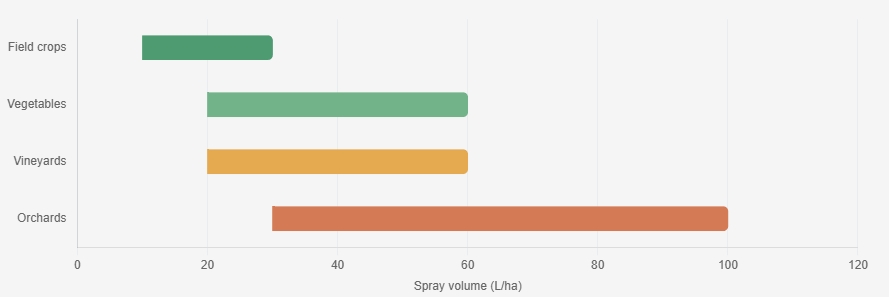
Actual application volume depends on the product label, crop stage, canopy density, target, and local regulations. Confirm requirements before choosing tank capacity and flight plans.
Assess Field Size, Terrain, and Obstacles
A spray drone should match the shape and workload of your fields, not just their total acreage. Measure each block and note narrow sections, headlands, and distant refill points. A large tank may reduce refill trips, but it can add weight and limit useful flight time. Compare the expected coverage per battery with the distance between the launch area and the far edge. A small field with many turns can take longer than a larger, open block. That estimate is easy to miss.
Tips: Walk the field edge before choosing. Mark trees, poles, wires, sheds, and wet ground on a simple map. Look up. Note where obstacles cluster, not only where they stand.
Terrain matters, too. Slopes, terraces, soft soil, and uneven ground can affect takeoff spots and safe access for refilling. Check whether the drone’s operating guidance suits the slopes and conditions you actually have. A clear route may be safer than squeezing between obstacles, even if it adds a few minutes. Revisit the map after harvest or pruning; field edges and branches change. I would not rely on a map alone. A quick on-site check can reveal the one low wire you forgot.
Compare Drone Capacity, Coverage, and Battery Life
When comparing spray drones, start with tank capacity, but do not treat a larger tank as an automatic advantage. A full load adds weight and may reduce flight time, especially over sloped or uneven fields. Estimate how much liquid your usual blocks require, then consider refill distance and setup time. A small tank can work well near a water source. Far from one, repeated refills become tiring.Coverage depends on more than the advertised spray width. Wind, crop height, row spacing, and flight speed can change how evenly droplets reach plants. Ask how the drone’s coverage figures were measured, and test a small section before planning a full day. Watch for missed strips near field edges. They happen.Battery life should be judged under working conditions, not only from a best-case figure. A loaded drone, frequent turns, and hot weather may shorten each flight. Check how long charging takes and whether spare batteries fit your daily routine. Keep a simple log of flight time, area treated, and refill breaks; after a few outings, those numbers are more useful than a brochure estimate. I would leave a margin in the schedule. Field plans rarely stay perfect.
Evaluate Spray Systems and Precision Controls
A spray drone’s value depends on how evenly it applies liquid, not just how much it carries. Match the spray system to your crops, canopy density, and typical field conditions. Check the pump’s adjustable flow range, nozzle options, and whether the system maintains steady pressure as the drone changes speed. For example, uneven output can leave visible gaps along a leafy row. Small differences matter.Look closely at precision controls. Terrain-following sensors can help maintain a consistent height over gentle slopes, while route planning should let you adjust swath width, speed, and turn behavior. Confirm that the display shows remaining liquid and alerts you to low flow or blocked nozzles. Test these features with clean water over a measured strip, then inspect the ground for missed areas or excess overlap. Conditions change; wind and crop height can affect results even with careful settings. It is tempting to trust a neat map on the screen, but the field may tell a different story. Compare the recorded route with the actual spray pattern, and recalibrate when results vary. Follow the equipment instructions and use only settings appropriate for the product being applied.
Check Safety Features, Regulations, and SupportHow to Choose the Best Spray Drone for Your Farm?
A capable spray drone should fit your fields and protect the people operating it. Check for a clearly marked emergency stop, reliable return-to-home settings, and alerts for low battery or weak signal. Obstacle sensors can help near trees and poles, but they are not a substitute for a clear flight path. Ask how the system behaves if communication drops. A feature list may look reassuring; real operating conditions are less tidy.
Tips: Before buying, walk a typical field and note power lines, slopes, and nearby homes. Test safety functions in a controlled area with an empty tank. Keep records of training and maintenance.
Rules vary by location and may cover pilot qualifications, aircraft registration, chemical application, and where flights are permitted. Check current requirements with the relevant aviation and agricultural authorities before purchase. Also ask the seller for practical training, written maintenance guidance, and clear warranty terms. Confirm that replacement parts and qualified service are available during your spray season. A low price can lose its appeal when a pump or battery sits unrepaired. I would compare support response times, not just promises; that detail is easy to overlook.
Compare Total Costs and Select a Suitable Model
Choosing a spray drone by purchase price alone can make a costly mistake. Compare the full cost over several seasons, then divide it by the area you expect to treat. Include batteries, chargers, replacement parts, routine maintenance, training, and storage. Check whether local service is available; a low-cost model is less attractive if one damaged pump sits idle for weeks. Check the math.Estimate real daily coverage, not just the figure in a product specification. A larger tank may reduce refill stops, but it can also require more battery power and careful handling. Consider field shape, crop height, water access, and how far the operator must walk between takeoff points. Small details matter. Ask sellers for a written estimate of battery life and maintenance intervals under conditions similar to your farm. Then compare those figures with a typical workday, including charging delays and cleaning time. The spreadsheet may still be wrong; weather and uneven fields disrupt neat plans. Choose a model whose payload and flight time fit your usual jobs, with enough capacity for busy periods but not so much that the added cost goes unused. A modest, serviceable setup may suit a small farm better than a high-capacity model.
How to Choose the Best Spray Drone for Your Farm? — Compare Total Costs and Select a Suitable Model
| General model class | Tank capacity | Typical effective field capacity | Estimated initial package cost (USD) | Estimated annual ownership costs (USD) | Estimated 3-year total cost (USD) | Best suited for |
|---|---|---|---|---|---|---|
| Compact | About 10 L | About 4–8 acres/hour | Aircraft: $8,000Batteries: $2,000Charger: $800Spares and setup: $1,700Total: $12,500 | Service and parts: $800Battery replacement reserve: $1,200Insurance and administration: $1,000Total: $3,000/year | $21,500 | Smaller farms, orchards, irregular fields, or operators with modest seasonal workloads. |
| Mid-size | About 20 L | About 8–15 acres/hour | Aircraft: $14,500Batteries: $3,600Charger: $1,200Spares and setup: $2,200Total: $21,500 | Service and parts: $1,200Battery replacement reserve: $2,000Insurance and administration: $1,200Total: $4,400/year | $34,700 | Mixed-size farms seeking a balance between purchase cost, payload, and daily coverage. |
| Large-capacity | About 30 L | About 12–22 acres/hour | Aircraft: $22,000Batteries: $5,000Charger: $1,800Spares and setup: $3,000Total: $31,800 | Service and parts: $1,800Battery replacement reserve: $3,000Insurance and administration: $1,500Total: $6,300/year | $50,700 | Larger, accessible fields with enough seasonal work to make higher capacity worthwhile. |
Estimates are illustrative USD figures for comparing model classes, not supplier quotes. Three-year total cost equals the estimated initial package cost plus three years of estimated ownership costs. Field capacity varies with application rate, field shape, terrain, weather, refill time, and local operating requirements. Estimates exclude chemicals, labor, taxes, financing, transport vehicles, and any infrastructure not listed.
Precision Crop Care from Above with the AL6-30 6-Rotor Spraying Drone and Helicopter-Grade Engine
AL6-30 6-Rotor Agricultural Spraying Drone with Helicopter-Grade Engine
Precision crop care depends on placing treatment where it is needed, while keeping field operations efficient. The AL6-30 6-rotor spraying drone is designed for professional farm use, combining a six-rotor platform with a helicopter-grade engine to support powerful, consistent crop treatment. Its aerial operation can help crews reach large or difficult-to-access areas without relying solely on ground equipment, making it a practical option for farms seeking greater flexibility in their spraying workflow.Water and input efficiency are increasingly important considerations in agriculture. FAO AQUASTAT data indicate that agriculture accounts for about 72% of global freshwater withdrawals, underscoring the value of careful resource management. By enabling targeted application and reducing the need to move machinery through fields, an aerial spraying system can support more considered crop-care routines, subject to appropriate operating conditions and application plans. The AL6-30 is built to deliver the capacity and power professional operators need to cover crops efficiently, helping farms adapt treatment schedules to field conditions and seasonal demands.
Conclusion
Choosing the best Spray Drone for your farm starts with understanding your crops, application needs, and the areas you need to cover. Consider field size, terrain, slopes, and obstacles, since these affect how easily a drone can operate and how much coverage you need per flight. Compare tank capacity, spray coverage, and battery life to find a balance between efficient work and practical operating time.Look closely at the spray system and precision controls, including whether they can deliver the application pattern and level of accuracy your crops require. Safety features, applicable operating requirements, and access to maintenance or technical support also matter. Finally, compare the total cost, including equipment, upkeep, and necessary accessories. Weigh these factors against your farm’s specific priorities to select a suitable model rather than focusing on any single specification.
About Us
We turn drones from tools into infrastructure, enabling the global low altitude economy with engineering rigor and compliance.To become the core infrastructure provider for the global low altitude economy. We will keep integrating 5G, AI and hydrogen energy to drive standardized, intelligent and green aerial operations.
Media Contact
Company Name: UUUFLY AeroTech Corp.
Contact Person: Media Relations
Email: Send Email
Country: China
Website: https://www.viscolift.com/
Press Release Distributed by ABNewswire.com
To view the original version on ABNewswire visit: How to Choose the Best Spray Drone for Modern Farm Operations
