

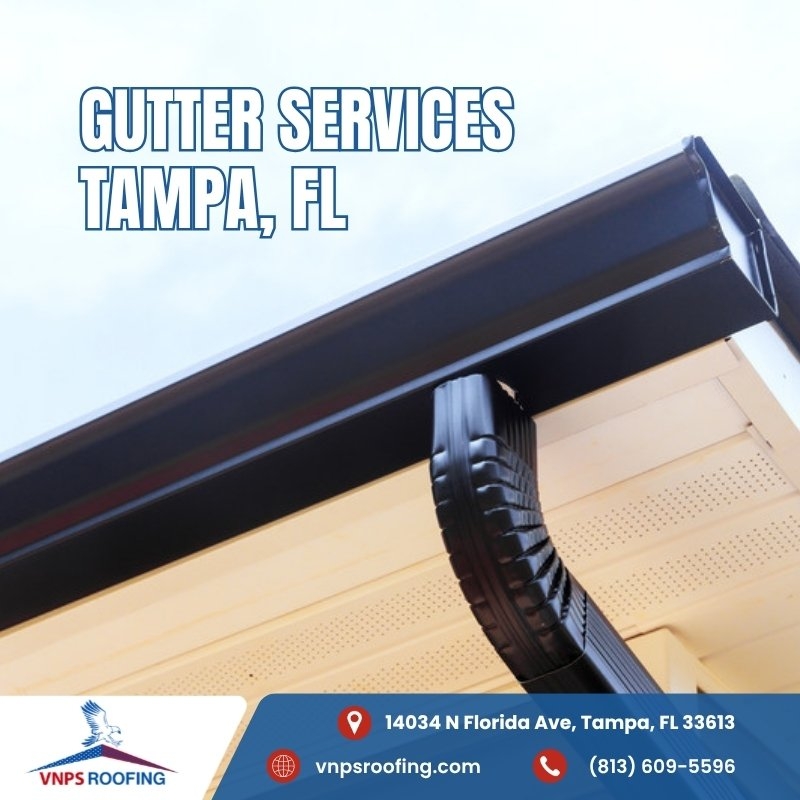
TAMPA, FL – September 17, 2026 – VNPS Roofing, a Tampa gutter installation and repair contractor, is explaining how a home’s gutter system works alongside its roof to move water safely away from the structure, as Hillsborough County moves through the peak weeks of the Atlantic hurricane season. According to the National Hurricane Center, the season’s statistical peak falls on September 10, with the heaviest concentration of storm activity running from mid-August through mid-October, the same stretch that typically delivers Tampa’s heaviest monthly rainfall.
Rainfall data compiled by the Florida Climate Center at Florida State University show that Tampa averages 9.03 inches of rain in August and 6.09 inches in September under the 1991–2020 climate normals, following a similarly wet June and July. A roof sheds that volume of water onto whatever collection system sits at its edge, and the condition of that system determines where the water goes next.
“A roof is only half the water-protection story,” said Ruben Calles, owner of VNPS Roofing. “The gutters and downspouts are what decide whether that rain leaves the property or sits against the house.”
The mechanics of that failure are documented by the U.S. Department of Energy’s Building America Solution Center, which explains that when gutters and downspouts do not carry roof runoff away from a house, “the immense volume of water coming off the roof can quickly saturate the soil surrounding the building and wick through the foundation to the interior,” a process that can lead to mold and rot once moisture reaches inside. The same guidance recommends piping downspout discharge to a point at least five feet from the foundation on a grade sloped away from the building, so water reaches “daylight” well clear of the structure rather than pooling at its base.
Federal flood-preparedness guidance treats gutter upkeep as a baseline defense rather than an optional extra. FEMA’s National Flood Insurance Program, through its FloodSmart.gov consumer site, advises homeowners to clear debris from gutters and downspouts specifically to prevent water from accumulating where it can cause damage. The agency lists that step alongside larger flood-mitigation measures.
Locally, the City of Tampa’s Stormwater Department handles the maintenance and retrofitting of public drainage structures and storm sewers and takes resident reports of local flooding problems. The systems attached to a private roofline, including gutters, downspouts, and guards on the house itself, remain the homeowner’s responsibility to maintain.
“We see the same pattern every rainy season,” Calles said. “A gutter that’s sagging, pulling away from the fascia, or clogged with debris doesn’t fail quietly. It shows up as water finding its way somewhere it shouldn’t, whether that’s the fascia board, the soffit, or the foundation line.” He added that most of the calls VNPS gets during peak season trace back to a gutter problem that had been building for months before the heavy rain exposed it.
VNPS Roofing’s gutter services cover the range of what a system needs to keep functioning through the wet season: seamless gutter installation sized and pitched to the specific roofline, repair of leaking seams and sagging sections before they pull loose, and micro-mesh gutter guards intended to help reduce debris buildup after a system has been cleaned out. The company says gutter and guard product selection depends on the roofline, drainage needs, debris exposure, and project scope.
Each job follows a four-step process: an inspection of the existing system, a drainage evaluation with specific recommendations, the repair or installation work itself, and a flow test that confirms water is actually reaching a downspout and discharging where it should, rather than assuming a repaired section is working because it looks intact.
Customer feedback cited by VNPS Roofing also points to the role follow-up service can play after rain exposes a drainage issue. In one review, customer JC Whelchel wrote that after a reroofing project, “one small issue I found with a gutter after the first rain was repaired within a day” after contacting the company. The comment aligns with the company’s position that gutter performance should be checked after installation or repair, not judged only by appearance.
“Preparation is key,” Calles said. “By the time a homeowner notices staining on the fascia or standing water by the foundation, the gutter system has usually been failing for a while. Catching it in September, while the season is still active, costs a lot less than catching it after a storm has already pushed water where it doesn’t belong.”
Additional information about VNPS Roofing’s gutter services is available at https://vnpsroofing.com/gutter-services/. The company serves Tampa, Lutz, Brandon, Riverview, and surrounding areas across Hillsborough, Pasco, and Pinellas Counties.
About VNPS Roofing
VNPS Roofing, operated by Veterans National Property Services, is a Florida Certified Roofing Contractor (License CCC1332569) founded in 2014 and based in Tampa, Florida. The company’s main phone number is (813) 609-5596. VNPS Roofing is a designated Service-Disabled Veteran-Owned Small Business (SDVOSB) and holds manufacturer credentials including Owens Corning Preferred Contractor and Duro-Last Certified Installer status. VNPS provides residential and commercial roof inspection, installation, repair, and replacement, along with gutter installation, repair, and guard systems, serving Hillsborough, Pasco, and Pinellas Counties.
Media Contact
Company Name: VNPS Roofing
Contact Person: Ruben Calles
Email: Send Email
Address:14034 N Florida Ave
City: Tampa
State: FL 33613
Country: United States
Website: https://vnpsroofing.com/
Press Release Distributed by ABNewswire.com
To view the original version on ABNewswire visit: VNPS Roofing Explains Gutter Performance Role in Tampa Roof Water Protection
