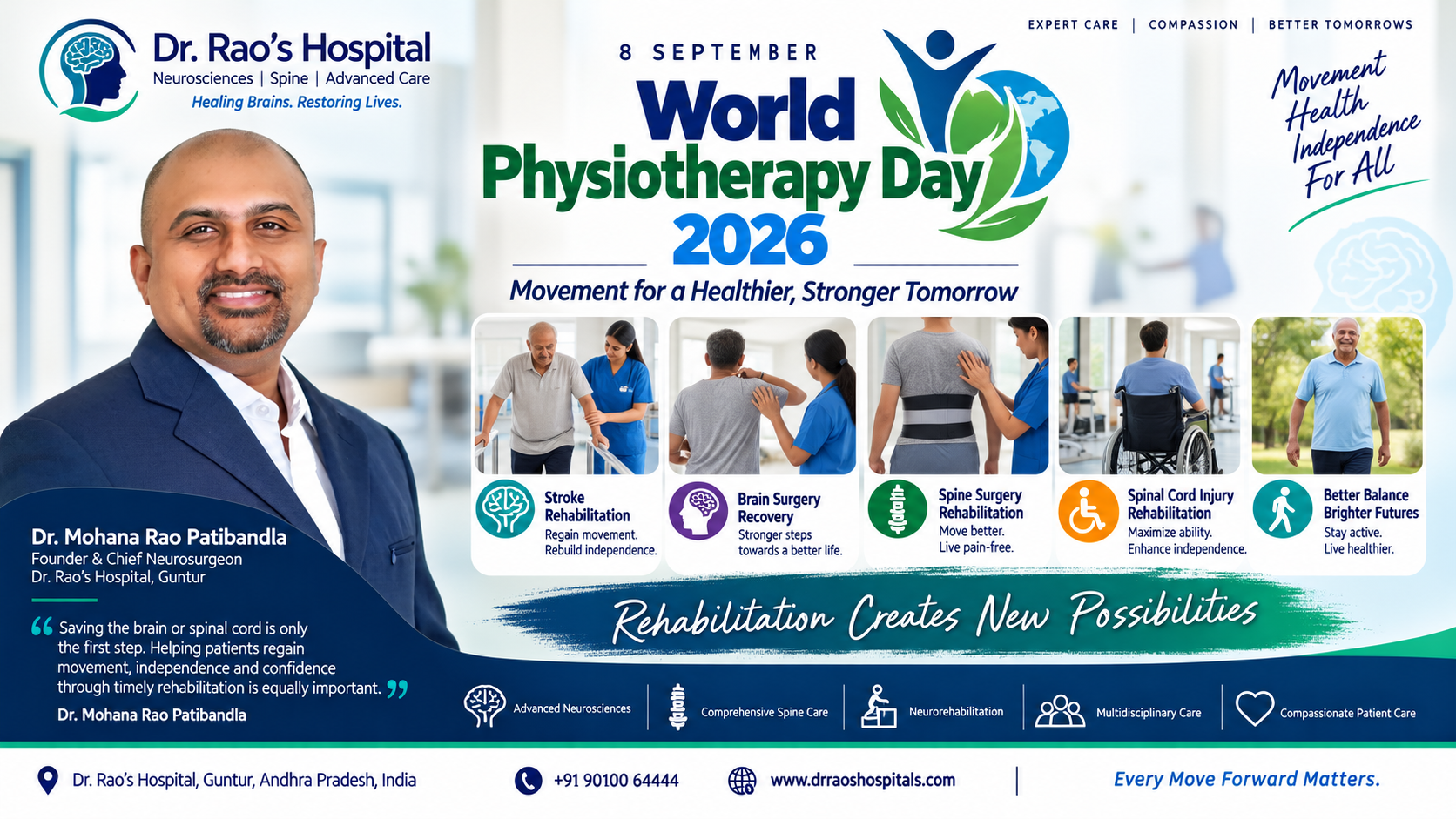
Dr. Mohana Rao Patibandla explains how early neurorehabilitation improves recovery after stroke, brain surgery, spine surgery, and spinal cord injury.
GUNTUR, ANDHRA PRADESH, INDIA, September 8, 2026 /EINPresswire.com/ — World Physiotherapy Day 2026: Dr. Mohana Rao Patibandla Highlights the Vital Role of Early Neurorehabilitation in Stroke, Brain, and Spine Recovery
On World Physiotherapy Day 2026, Dr. Mohana Rao Patibandla, Founder and Chief Neurosurgeon of Dr. Rao’s Hospital – International Institute of Neurosciences (IIN), Guntur, emphasized that early physiotherapy and specialized neurorehabilitation are essential for improving recovery after stroke, brain surgery, spinal cord injury, traumatic brain injury, and complex spine surgery. He said rehabilitation should begin as early as medically appropriate and continue through a personalized, multidisciplinary recovery program to maximize independence, mobility, and quality of life.
Observed globally every year on September 8, World Physiotherapy Day recognizes the invaluable contribution of physiotherapists in restoring movement, preventing disability, and improving long-term health outcomes. The 2026 campaign highlights the role of physiotherapy in stroke rehabilitation, cardiovascular health, and physical activity, reinforcing the importance of early rehabilitation for neurological recovery.
Early Neurorehabilitation Can Transform Recovery
According to Dr. Mohana Rao Patibandla, successful neurosurgery or emergency stroke treatment is only the beginning of a patient’s recovery journey.
“Saving the brain or spinal cord is only the first step. Helping patients regain movement, independence, confidence, and quality of life through timely neurorehabilitation is equally important. Early physiotherapy combined with specialized neurological care can significantly improve long-term outcomes.”
Dr. Rao explained that advances in neurosurgery, endovascular stroke treatment, minimally invasive spine surgery, and neurocritical care have dramatically improved survival. However, the quality of recovery depends heavily on structured neurorehabilitation delivered by experienced physiotherapists working alongside neurologists, neurosurgeons, rehabilitation specialists, speech therapists, occupational therapists, and specialized neuroscience nursing teams.
Neurological Conditions That Benefit from Physiotherapy
At Dr. Rao’s Hospital, physiotherapy is an integral part of comprehensive neuroscience care for patients recovering from:
Ischemic and hemorrhagic stroke.
Brain tumor surgery and skull base surgery.
Traumatic brain injury (TBI).
Spinal cord injury.
Cervical and lumbar spine surgery.
Parkinson’s disease and movement disorders.
Peripheral nerve injuries and neurological weakness.
Every rehabilitation program is individualized according to the patient’s neurological condition, mobility, strength, balance, functional goals, and recovery timeline.
Stroke Rehabilitation Begins Early
Stroke remains one of India’s leading causes of long-term disability. Dr. Rao emphasized that early rehabilitation is one of the most important interventions for reducing disability and improving functional independence.
For medically stable stroke patients, supervised physiotherapy can begin early during hospitalization under specialist guidance. Early rehabilitation focuses on:
Improving walking ability and balance.
Restoring strength in weakened limbs.
Enhancing coordination and mobility.
Preventing muscle stiffness and joint contractures.
Reducing the risk of falls.
Helping patients regain independence in daily activities.
Dr. Rao stressed that every stroke survivor deserves a personalized rehabilitation plan supervised by a multidisciplinary neuroscience team.
Rehabilitation After Brain Surgery Improves Functional Recovery
Patients recovering from brain tumor surgery, aneurysm surgery, epilepsy surgery, hydrocephalus surgery, and traumatic brain injuries frequently experience weakness, balance disturbances, or coordination difficulties.
Dr. Rao explained that postoperative physiotherapy helps patients:
Regain muscle strength.
Improve posture and coordination.
Restore gait and balance.
Increase endurance.
Return safely to work and everyday activities.
Early mobilization also reduces complications associated with prolonged bed rest and accelerates functional recovery.
Spine Surgery Recovery Requires Structured Physiotherapy
Modern spine surgery enables many patients to begin mobilization much earlier than before. Following cervical or lumbar spine surgery, physiotherapy plays an essential role in:
Safe postoperative mobilization.
Core muscle strengthening.
Posture correction.
Flexibility and mobility exercises.
Functional movement training.
Return-to-work rehabilitation.
Rehabilitation programs are customized according to the type of spine surgery and each patient’s neurological recovery.
Spinal Cord Injury Rehabilitation Is Multidisciplinary
Patients with spinal cord injuries require comprehensive rehabilitation aimed at maximizing independence and improving quality of life.
Physiotherapy focuses on:
Muscle strengthening.
Standing and mobility training where appropriate.
Wheelchair mobility and transfer training.
Balance and coordination exercises.
Prevention of pressure injuries and complications.
Management of spasticity and functional mobility.
Dr. Rao noted that rehabilitation should begin during hospitalization whenever clinically appropriate and continue after discharge through structured follow-up.
Balance, Mobility, and Fall Prevention
Neurological physiotherapy also benefits patients with Parkinson’s disease, peripheral neuropathy, vestibular disorders, and age-related balance problems.
Balance rehabilitation helps patients:
Improve stability while walking.
Reduce fall risk.
Increase confidence during movement.
Maintain independence and quality of life.
Dr. Rao encouraged patients not to ignore persistent imbalance or repeated falls, as these symptoms may indicate underlying neurological disorders requiring specialist evaluation.
Physical Activity Supports Brain Health
World Physiotherapy Day also promotes regular physical activity as an important component of neurological and cardiovascular health.
Dr. Rao highlighted that appropriate physical activity contributes to:
Better cardiovascular health.
Reduced stroke risk.
Improved brain function.
Faster neurological recovery.
Better mental health and overall well-being.
He advised patients recovering from neurological illnesses to remain physically active under professional guidance rather than avoiding movement due to fear.
Dr. Rao’s Hospital’s Comprehensive Neurorehabilitation Approach
At Dr. Rao’s Hospital – International Institute of Neurosciences (IIN), Guntur, neurorehabilitation is integrated into comprehensive neurosciences care through collaboration between neurosurgeons, neurologists, physiotherapists, rehabilitation specialists, neurocritical care physicians, speech therapists, occupational therapists, and specialized nursing teams.
The hospital’s neurorehabilitation program includes:
Early neurological assessment.
Personalized rehabilitation planning.
Stroke rehabilitation.
Brain surgery rehabilitation.
Spine surgery rehabilitation.
Spinal cord injury rehabilitation.
Balance and gait training.
Functional independence and long-term recovery programs.
This multidisciplinary approach helps patients achieve better mobility, independence, and quality of life after neurological illness or surgery.
A Message to Patients and Families
Dr. Rao urged patients and caregivers not to delay rehabilitation following stroke, brain surgery, spinal cord injury, or spine surgery.
“Recovery is a process, not a single event. Early physiotherapy, consistent rehabilitation, family participation, and regular follow-up together provide patients with the best opportunity to regain independence and return to meaningful daily life.”
He encouraged individuals experiencing weakness after stroke, persistent back pain following spinal injury, difficulty walking, balance problems, or neurological disability to seek timely evaluation and rehabilitation from a specialized neuroscience team.
About Dr. Mohana Rao Patibandla
Dr. Mohana Rao Patibandla is an internationally fellowship-trained neurosurgeon, spine surgeon, and founder of Dr. Rao’s Hospital – International Institute of Neurosciences (IIN) in Guntur, Andhra Pradesh. After completing his MBBS from Andhra Medical College, Visakhapatnam (2002) and M.Ch. Neurosurgery from Nizam’s Institute of Medical Sciences (NIMS), Hyderabad (2013), he pursued advanced fellowship training in India and the United States across multiple neurosurgical subspecialties, including minimally invasive skull base surgery, pediatric neurosurgery, neuro-oncology, functional and stereotactic radiosurgery, and endovascular and cerebrovascular neurosurgery.
With more than two decades of clinical experience, Dr. Rao is recognized for his expertise in minimally invasive brain surgery, complex spine surgery, cerebrovascular and stroke surgery, pediatric neurosurgery, brain tumor surgery, epilepsy surgery, and advanced endovascular neurosurgery. Under his leadership, Dr. Rao’s Hospital has grown into one of India’s dedicated neuroscience centers, bringing advanced technologies such as neuronavigation, intraoperative neuromonitoring, hybrid neurovascular operating facilities, minimally invasive neurosurgical systems, and comprehensive neurorehabilitation services to patients in Andhra Pradesh and across India.
Dr. Rao has received national and international recognition for advancing neuroscience care and has been featured in leading publications for his contributions to minimally invasive neurosurgery and comprehensive brain and spine care in India.
About Dr. Rao’s Hospital – International Institute of Neurosciences (IIN)
Dr. Rao’s Hospital – International Institute of Neurosciences (IIN) is a dedicated neuroscience hospital in Guntur, Andhra Pradesh, specializing in neurology, neurosurgery, spine surgery, stroke care, neuro-oncology, pediatric neurosurgery, cerebrovascular surgery, endovascular neurosurgery, epilepsy surgery, minimally invasive brain and spine surgery, and comprehensive neurorehabilitation.
The hospital provides advanced diagnosis, emergency neurological care, surgical treatment, neurocritical care, minimally invasive brain and spine procedures, rehabilitation, and long-term recovery services for patients across Andhra Pradesh and India.
1. When should physiotherapy begin after a stroke?
Early physiotherapy is one of the most important components of stroke recovery. Dr. Mohana Rao Patibandla explains that, for many medically stable stroke patients, rehabilitation can begin within the first 24–48 hours under specialist supervision, depending on the patient’s neurological condition and overall medical stability. Early mobilization helps improve walking, balance, muscle strength, coordination, and independence while reducing complications associated with prolonged bed rest. Every stroke survivor should receive an individualized neurorehabilitation plan designed by a multidisciplinary neuroscience team.
2. Why is neurorehabilitation important after brain surgery?
Neurorehabilitation plays a vital role in helping patients recover after brain surgery for brain tumors, aneurysms, epilepsy, traumatic brain injury, hydrocephalus, and other neurological conditions. According to Dr. Rao, rehabilitation helps restore muscle strength, balance, coordination, speech, mobility, and functional independence. A structured rehabilitation program enables patients to safely return to their daily activities, work, and family life while improving long-term neurological recovery and quality of life.
3. How does physiotherapy help after spine surgery?
Physiotherapy is an essential part of recovery after cervical and lumbar spine surgery. It helps patients regain mobility, improve posture, strengthen core muscles, reduce pain, and restore flexibility. Dr. Rao emphasizes that rehabilitation is carefully tailored according to the type of spine surgery, neurological recovery, and individual functional goals. Early, supervised physiotherapy also helps patients return safely to routine activities and reduces the risk of long-term disability.
4. Can physiotherapy improve recovery after a spinal cord injury?
Yes. Physiotherapy is a cornerstone of spinal cord injury rehabilitation and helps maximize recovery and independence. Rehabilitation focuses on muscle strengthening, balance training, mobility exercises, wheelchair skills, transfer training, standing programs where appropriate, and prevention of complications such as pressure injuries and joint stiffness. Dr. Rao notes that recovery after a spinal cord injury requires a comprehensive, multidisciplinary approach with regular follow-up and individualized rehabilitation plans.
5. What is the role of neurorehabilitation in traumatic brain injury?
Traumatic brain injury (TBI) rehabilitation helps patients recover physical, cognitive, and functional abilities following head injuries. Neurorehabilitation includes gait training, balance rehabilitation, muscle strengthening, coordination exercises, and therapies aimed at improving daily functioning. Dr. Rao explains that early rehabilitation can significantly improve mobility, independence, and overall quality of life while helping patients adapt to neurological deficits during recovery.
6. Which hospital provides comprehensive neurorehabilitation in Andhra Pradesh?
Dr. Rao’s Hospital – International Institute of Neurosciences (IIN), Guntur, provides comprehensive neurorehabilitation as part of its advanced neurosciences program. The hospital offers multidisciplinary rehabilitation for patients recovering from stroke, brain surgery, spinal cord injury, traumatic brain injury, spine surgery, Parkinson’s disease, and other neurological disorders. Under the leadership of Dr. Mohana Rao Patibandla, the hospital integrates neurosurgery, neurology, physiotherapy, neurocritical care, speech therapy, occupational therapy, and rehabilitation services to help patients achieve the best possible neurological recovery.
Media Contact
Dr. Rao’s Hospital – International Institute of Neurosciences (IIN)
12-19-67, Old Bank Road, Kothapet, Guntur, Andhra Pradesh – 522001, India
Phone: +91 90100 64444
Email: info@drraoshospitals.com
Website: https://drraoshospitals.com – Dr. Rao’s Hospital – International Institute of Neurosciences (IIN)
Mohana Rao Patibandla
Patibandla Narayana Swamy Neurosciences LLP
+91 90100 56444
info@drraoshospitals.com
Visit us on social media:
LinkedIn
Instagram
Facebook
YouTube
X
Technology at Dr. Rao’s International Institute of Neurosciences
Legal Disclaimer:
EIN Presswire provides this news content “as is” without warranty of any kind. We do not accept any responsibility or liability
for the accuracy, content, images, videos, licenses, completeness, legality, or reliability of the information contained in this
article. If you have any complaints or copyright issues related to this article, kindly contact the author above.

Media gallery