

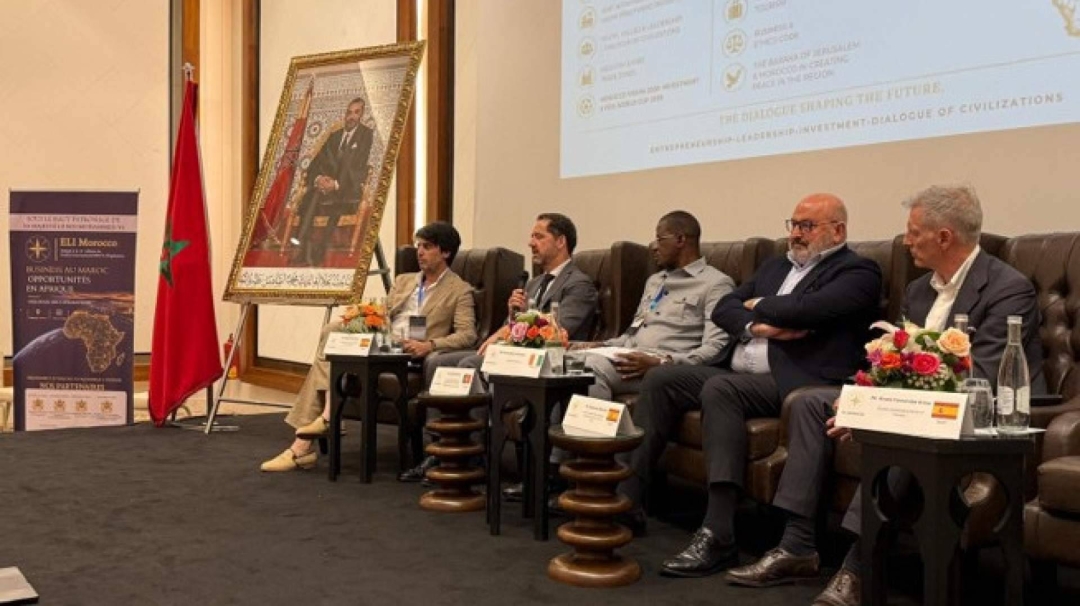
Some lines are built to make a room uncomfortable. The one the CEO of EstratégicaMente delivered from the podium at the Hilton Tangier Al Houara, before more than forty international leaders gathered at the ELI Morocco Forum 2026, did its job in under ten seconds:
“Did you know that a large part of our society is becoming dumber because of the misuse of AI?”
The silence that followed wasn’t disapproval — it was recognition. In a room accustomed to the polished language of diplomacy and to the predictable praise of technology’s future, the question landed like a fist on the table. For a few seconds, no one took notes. Then came the first tense smiles and, by the end of the talk, one of the liveliest conversations of the entire day. The economist had pulled off the hardest thing to achieve at a high-level forum: he got the audience to stop nodding on autopilot and start thinking.
The “cognitive debt” created by AI used badly
Taboada — a professor at the University of A Coruña and CEO of EstratégicaMente — had not taken the stage to talk about chatbots or quick productivity gains. His keynote, titled “AI with Judgment: Literacy, Governance, and Real Use Cases,” pointed to a far less discussed and considerably deeper risk: the uncritical, superficial adoption of artificial intelligence is breeding a new form of functional illiteracy.
The argument is as simple as it is unsettling. When a person or an institution delegates a cognitive task without understanding what they are delegating, they don’t save time — they lose judgment. They automate processes without governance, mistake speed for intelligence and, little by little, let the muscle of independent reasoning atrophy. “It isn’t the tool that makes us dull,” Taboada argued, “but our refusal to understand what the tool is doing for us.”
The provocation, far from gratuitous, connects with the most recent scientific evidence. In 2025, a team at the MIT Media Lab led by researcher Nataliya Kos’myna published the study “Your Brain on ChatGPT: Accumulation of Cognitive Debt,” which used electroencephalography to monitor 54 participants over four months. The result? The group that wrote with the help of a language model showed the weakest neural connectivity and the poorest learning outcomes compared with those who wrote unaided. The researchers coined a term that captures the danger: “cognitive debt,” the deferred cost of outsourcing thought without reflection. Caution is warranted — it is a preliminary study, not yet peer-reviewed — but the direction is unmistakable. Seen this way, the line delivered in Tangier was not an outburst but the bluntest version of a debate already circulating through universities and laboratories.
“Literacy in and governance of artificial intelligence are absolutely essential in order to exercise active, positive, and effective control — and to avoid sliding into a situation where human beings become mindless actors.”
Slow AI: the slow revolution against tech’s rush
Faced with this diagnosis, Taboada didn’t leave the room with only the scare. He presented his own approach: Slow AI, a “slow artificial intelligence” drawing on the same philosophy as slow food or slow journalism. Against the rush of the tech sector, it champions the pause, deliberation, and judgment.
Slow AI inverts the market’s dominant reflex. Instead of adopting first and understanding later, it proposes the opposite: stop, strip away the superfluous, simplify, and only then automate — with human judgment as the non-negotiable anchor of the entire process. It is, in a sense, a countercultural statement in an ecosystem obsessed with speed. Where the mainstream narrative celebrates automation as an end in itself, Slow AI returns it to its rightful place: a means, supervised by people who understand what’s at stake.
“Artificial intelligence shouldn’t replace judgment,” the economist summed up, “but force us to have it.” That is the essence of what he calls “AI with judgment”: using technology deliberately, under governance, and in service of human thinking rather than in its place.
“Slow AI: a European proposal for artificial intelligence with judgment.”
Two solutions already on the market
The keynote did not stay in the realm of theory. The speaker presented two Spanish-built tools already in operation that translate the Slow AI philosophy into concrete use cases:
Simplicity for Grants© supports the full life cycle of public funding — prospecting, eligibility, drafting, reporting, and auditing — demonstrating how AI can expand analytical capacity and traceability in complex processes while always keeping human oversight in decision-making. Throughout the weekend, the EstratégicaMente team was on hand for all attendees, matching their projects with funding from the European Union, the United Nations, and the World Bank.
Simplicity Lab© is an active-learning platform designed for universities and business schools. It responds directly to the opening warning: integrating artificial intelligence in a pedagogically responsible way, so that it strengthens students’ critical thinking instead of replacing it — precisely the muscle that, according to MIT, is at risk.
Both initiatives sparked immediate conversations with Moroccan, Spanish, and Portuguese participants, opening the door to collaborations along the Spain–Morocco–Africa corridor.
A forum spanning three continents
The ELI Morocco Forum 2026, held under the High Patronage of His Majesty King Mohammed VI and within the framework of the 14th MATA International Festival, is led by Nabil Baraka — president of both the MATA Festival and the ELI Morocco Forum — and brought together representatives from politics, diplomacy, business, and civil society across several continents. Much of the forum’s distinctive value rests on Baraka’s vision: his commitment to turning Morocco into a meeting point for business, institutional, and social leaders from different continents has consolidated a platform for dialogue that transcends the traditional conference format to become a genuine international laboratory for cooperation, business, and ethics.
The speaker lineup alone would have justified the trip from any European or African capital. The forum featured Ryad Mezzour, Morocco’s Minister of Industry and Trade; Younes Sekkouri, Minister of Economic Inclusion and Employment; Adib Benbrahim, Secretary of State for Housing; and Ahmed Bouzid, Director General of the Ministry of Energy Transition and Sustainable Development.
Next stop: Madrid and Lisbon
At the close of the gathering, Nabil Baraka announced the expansion of the ELI Forum to Madrid and Lisbon — a move that reinforces the international ambition of an increasingly established initiative as a meeting space among Europe, Africa, and the Arab world, and that strengthens the strategic role of the Atlantic-Mediterranean corridor as a platform for cooperation, innovation, ethics, and shared development. Guillermo Taboada has confirmed his participation in the upcoming editions.
While much of the market still measures the success of artificial intelligence by speed, automation, and cost reduction, an emerging current is raising a different question: how do we ensure that AI amplifies human judgment rather than replacing it? The Slow AI proposal presented in Tangier sits precisely along that line.
“Because the future will not depend solely on the intelligence of machines. It will depend, above all, on our ability to preserve the judgment, the responsibility, and the discernment we need to use them wisely.”
Who was in Tangier: top international talent
Among the Guests of Honor, alongside the ministerial representatives, the forum’s diplomatic dimension was present at the highest level: Enrique Ojeda Vila, Ambassador of Spain to Morocco; H.E. Damien Donavan, Ambassador of Australia; Luis Filipe Faro Ramos, Ambassador of Portugal; and Seynabou Dial, Ambassador of Senegal.
From the worlds of business and civil society came Mohamed Amersi, president of the Amersi Foundation & Inclusive Ventures Group (United Kingdom); Sanam Naraghi-Anderlini, CEO of the International Civil Society Action Network; Ekaterina Zagladina, president of the Secretariat of the Nobel Peace Summit; Jorge Gómez, investor and businessman (Spain); Eglantina Zingg, founder of Goleadoras (Venezuela); Majd Mashharawi, social innovator (Saudi Arabia); Dr. Yasemin Saib, corporate social responsibility specialist (United States); Vanessa Arelle, corporate diplomacy expert; Alvaro Fernández de Araoz, founder of Correcta/Advisory Board; Alejandro Romero, founder and CEO of Alto Intelligence; Ana Martinho, the first woman to lead the Portuguese diplomatic service; Marco Espinheira, Executive Director of Nova SBE; Kristoffer Nilaus Tarp, of Impact Fund Denmark; Guilherme Collares Pereira, former innovation director of the EDP Foundation; and Caoimhe McWeeney, European energy-transition expert.
Interreligious and intercultural dialogue had its own voices in Imam Qari Asim (United Kingdom), Rabbi Dr. Yitzchok Ben David (Israel), and Moses Garelik (Belgium). Moroccan academia was represented by Moumini Boushta, president of the universities of Tangier-Tetouan-Al Hoceima, and Ahmed Aliali, dean of the Faculty of Legal, Economic, and Social Sciences of Tangier.
Key players from Morocco’s institutional and business fabric also took part: Mounir Lymouri, president of the Communal Council of Tangier; Imad Barrakad, Chairman of the Management Board of the Moroccan Tourism Engineering Company (SMIT); Omar Moro, president of the Tangier-Tetouan-Al Hoceima Regional Council; Yanja El Khattat, president of the Dakhla-Oued Eddahab Regional Council; Hamdi Ould Errachid, president of the Laayoune-Sakia El Hamra Regional Council; Omar Kadaoui, president of CGEM North; Mohamed Bachiri, vice-president of the CGEM; Nassim Belkhayat, CEO of Neo Motors; Asmae Azizi, senior advisor; and Ahmed Bennis, Managing Director of Tanger Med Zones.
Key takeaways
What is “AI with judgment”? An approach that advocates using artificial intelligence deliberately, under governance and human oversight, prioritizing critical thinking over thoughtless automation.
What is Slow AI? The approach championed by EstratégicaMente. A “slow artificial intelligence,” in the family of slow food or slow journalism: it proposes pausing, simplifying, and automating only after understanding, with human judgment as the anchor.
What are Simplicity for Grants© and Simplicity Lab©? Two AI platforms from EstratégicaMente. The first optimizes the full public-funding cycle; the second integrates AI into higher education without weakening students’ critical thinking.
What is the ELI Morocco Forum? An international forum held under the High Patronage of His Majesty King Mohammed VI and led by Nabil Baraka, bringing together leaders from politics, diplomacy, business, and civil society across Europe, Africa, and the Arab world. Its next editions will be held in Madrid and Lisbon.
What is cognitive debt? The progressive loss of reasoning capacity that results from delegating mental processes to automated systems without understanding them.
Why does AI literacy matter? Because it allows artificial-intelligence tools to be used consciously, safely, and effectively, reducing the risks of dependency and errors of judgment.
What are the main risks of the thoughtless use of artificial intelligence?
Cognitive dependency.
Loss of critical thinking.
Automation without oversight.
Bias in decision-making.
Reduced capacity for learning.
Guillermo Taboada is an economist, CEO of EstratégicaMente, a professor at the University of A Coruña and at BEYOND AI Finance & Business School, and the author of ten books on artificial intelligence, leadership, and public funding. More information at estrategicamente.info.
#ELIMoroccoForum2026 #AIwithJudgment #SlowAI #SimplicityForGrants #SimplicityLab #Morocco #ArtificialIntelligence #AIGovernance #AILiteracy
Media Contact
Company Name: GUILLERMO TABOADA
Contact Person: Press Office
Email: Send Email
Country: United States
Website: https://simplicityforgrants.eu/
