BRIDGEPORT, CT – Nov. 23, 2026 – A new study by Sid Ali Ourradi, a Data Scientist at MediaScience and PhD researcher at the University of Bridgeport, found that artificial intelligence (AI) could predict which video advertisements viewers were more likely to keep on screen using just three seconds of footage and the ad’s total length. The research, involving 679 business professionals and 96 video ads, found that footage from the middle of an advertisement performed comparably to its opening three seconds or the entire video, challenging common assumptions about the importance of opening hooks in predicting viewer attention.
The study, by audience researcher Sid Ali Ourradi, a Data Scientist at MediaScience and PhD researcher at the University of Bridgeport, followed 679 business professionals as they scrolled a LinkedIn-style desktop feed. It covered 6,474 ad exposures across 96 video ads from 47 advertisers. The AI was always tested on advertisers it had never seen in training, and it worked from the video file alone, with no data about the viewers or the brand.
Three seconds were enough
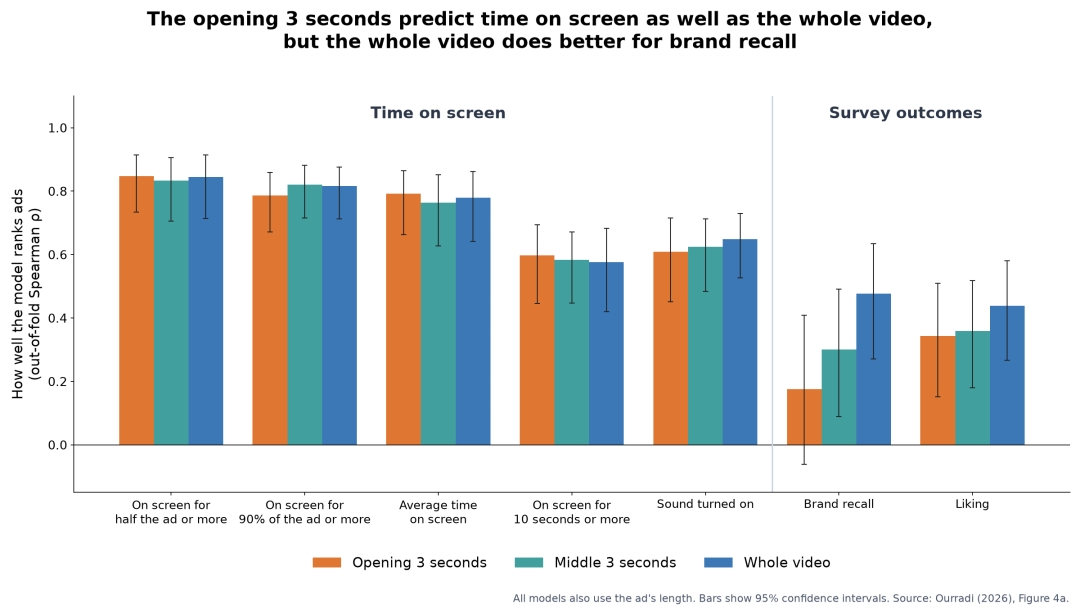
The AI ranked ads by how many viewers kept them on screen to the halfway point. Using the whole video, its ranking matched the real one with a correlation of 0.84 out of a possible 1.0 (95% confidence interval 0.71–0.91). Using the opening three seconds instead, it scored 0.85. Using three seconds from the middle, it scored 0.83. Every version also knew the ad’s length, which on its own managed 0.73 at best.
In short ads, a clip from the middle overlaps the opening. So the researcher repeated the test on the 83 ads long enough for the two clips to share no frames. The opening still had no clear advantage.
“Everyone works on the first three seconds. The model didn’t need them,” Ourradi said. “Three seconds from the middle of an ad told it almost as much as the whole video.”
It can pick between two ads
Shown two 15-second ads, the AI picked the one more people kept on screen to the halfway mark 64.6% of the time across 523 head-to-head pairs (95% CI 52.8%–75.4%). A coin flip gets 50%. Almost all of those pairs came from different advertisers; the study had too few pairs from the same brand to test choosing between one brand’s own ads.
But watching isn’t remembering
After the session, participants were asked to name the brands they had seen, without prompts. Here three seconds were not enough. The AI predicted brand recall clearly better from the whole video (0.48) than from the opening (0.18) or the middle (0.30).
Screen time was also a poor guide to memory. Of 15 links between on-screen measures and recognition, brand recall or liking, 13 were statistically inconclusive.
“Remembering the brand is a separate challenge,” Ourradi said. “Creative teams should measure both.”
What the study does not show
It tested what the AI needed to make its prediction. It does not show that an ad’s opening is unimportant to viewers.
The 0.84 measures how closely the AI’s ranking matched the real one. It is not an 84% success rate on individual viewers.
“On screen” means the ad was visible in the feed. The study did not check that people were looking at it.
The AI ranks ads. It did not clearly beat a length-only model at forecasting exact view rates.
The results come from one professional audience on desktop. Phones, consumer audiences and live campaigns are untested.
The findings are reported in the research manuscript “Visual Content Improves the Ranking of In-Feed Video Ads by Audience Time on Screen,” which has not yet been peer reviewed. The manuscript is available as a preprint on SSRN (https://papers.ssrn.com/abstract=7496618).
About Sid Ali Ourradi
Sid Ali Ourradi is a Data Scientist at MediaScience and a PhD researcher at the University of Bridgeport. His work applies machine learning to advertising research, studying how audiences respond to video ads and what can be predicted from the creative itself. ORCID: 0009-0001-1705-7033.
Media Contact
Company Name: MediaScience
Contact Person: Sid Ali Ourradi
Email: Send Email
Country: United States
Website: https://papers.ssrn.com/abstract=7496618